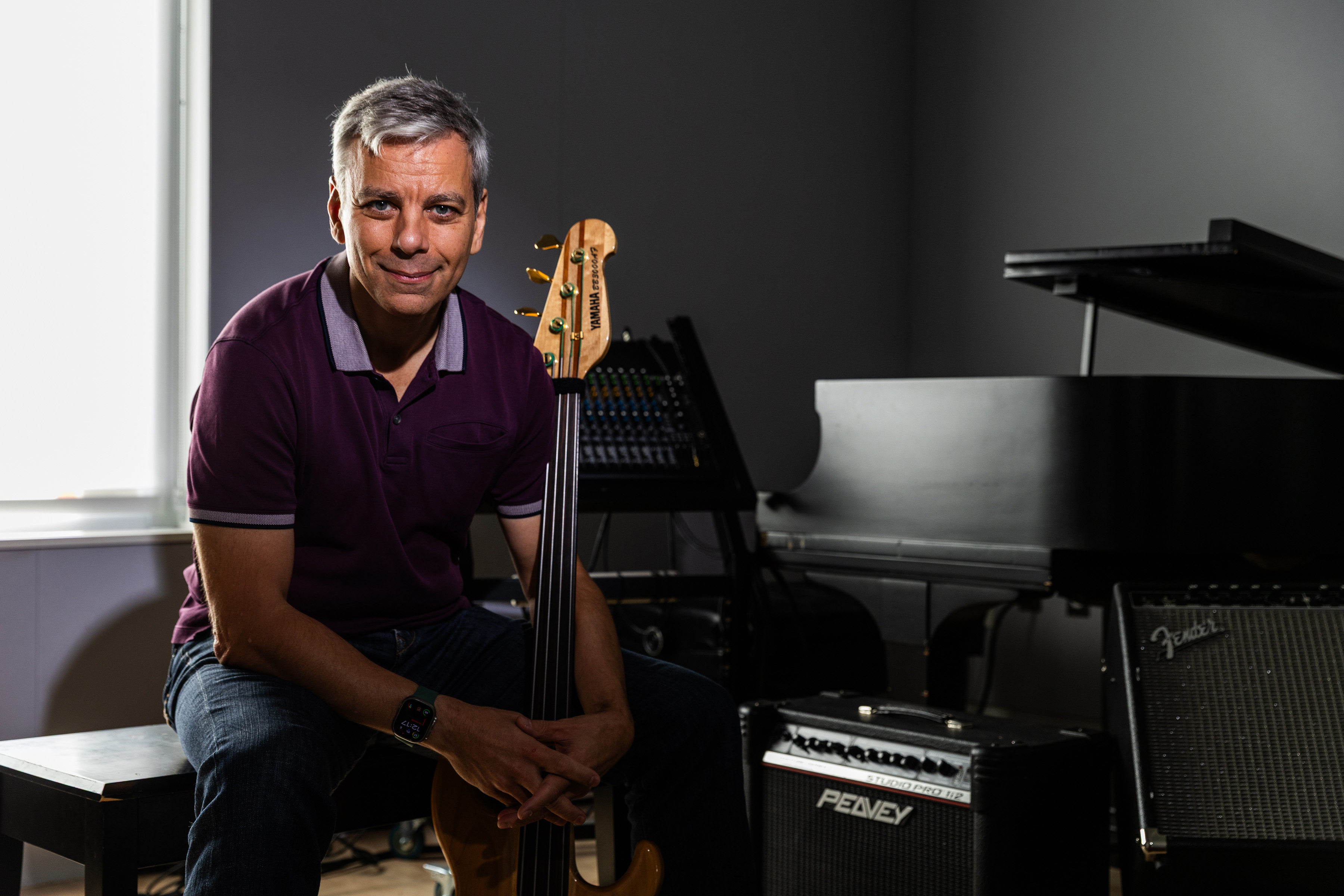
“That little synthesizer had a operate that allowed you to make your personal sounds, and I grew to become utterly captivated by the chances,” he says.
Synthesizers have been taking a extra distinguished place in pop music throughout the Eighties, including to his fascination with the know-how.
As he superior by way of faculty, Smaragdis wished to check music made with synthesizers. However this was not an academic path supplied by the extra conventional European conservatories on the time.
As an alternative, he enrolled at Berklee School of Music in Boston, right into a program the place he may discover the usage of computer systems and synthesizers to form and manipulate sound.
“With computer systems and synthesizers, I may make new sounds which have by no means been heard earlier than,” he says.
On the identical time, Smaragdis grew to become immersed in jazz fusion. He declared bass as his main at Berklee since it might permit him extra alternatives to play with jazz ensembles.
“I discovered the bass to be sonically extra fascinating than the guitar. It was a extra unexplored area, and I’ve all the time gravitated towards unexplored domains,” he says.
That curiosity within the unexplored carried over into his coursework. He and mentor Richard Boulanger, a professor of digital manufacturing and design, created new instruments to assist folks use computer systems to put in writing, produce, and improve music.
By way of his research at Berklee, Smaragdis launched into a collaborative undertaking with Professor Barry Vercoe (who handed away in 2025) on the MIT Media Lab to create software program synthesizers for music creation. Constructing on that undertaking, Smaragdis pursued graduate research in Vercoe’s group, the place he accomplished his grasp’s diploma and PhD, adopted by a postdoc.
“Within the Media Lab, I bought uncovered extra to the pc a part of laptop music. That’s the place my consideration shifted a bit. Now I actually wished to make computer systems that would perceive sound,” he says.
Tuning in to unexplored domains
At the moment, many college students within the Media Lab have been utilizing sign processing methods to assist machines deal with sound. Smaragdis selected a much less explored method — machine studying — to separate himself from the pack.
He discovered that coaching machine-learning fashions to grasp sound supplied benefits that couldn’t be attained with conventional sign processing methods.
“Over time, it grew to become actually clear to me that we have to educate computer systems the right way to pay attention. We will’t simply inform them the right way to pay attention. If something, we don’t even know the way we people pay attention,” he says. “We don’t have a vocabulary to clarify what it means to pay attention, or the right way to inform the distinction between a cat’s meow and the sound of a violin.”
After ending his postdoc, Smaragdis started a profession at Mitsubishi Electrical Analysis Labs, the place he labored on synthetic intelligence programs that would scan video soundtracks and perceive what is occurring on display screen.
“What for those who document a whole soccer recreation, however you solely wish to watch the highlights? In laptop imaginative and prescient, it is vitally troublesome to determine what a spotlight is. However then again, for those who solely hearken to the sounds, then when the gang goes loopy you’d know that one thing fascinating is occurring,” he says.
That system was ultimately integrated into digital units, together with a private video recording system Mitsubishi was creating on the time, and into visitors monitoring programs and cell telephones.
Smaragdis later joined Adobe, the place he created the audio analysis staff that constructed user-friendly instruments to assist artists, musicians, and producers manipulate sound without having a number of experience.
“As we did that work, I stored arising with deeper technical issues that wanted to be resolved. I jumped into academia to deal with that itch,” he says.
Smaragdis joined the school on the College of Illinois at Urbana-Champaign, the place he and his group integrated the newest machine-learning methods into audio-processing programs.
One of many applied sciences they developed utilized neural networks for separating particular person sounds from audio mixtures. That undertaking caught the eye of the staff engaged on the 2021 documentary mini-series “The Beatles: Get Again.”
The manufacturing staff enlisted Smaragdis to assist clear up some archival Beatles recordings.
“That was a really totally different manner of audio processing than what I used to be doing in academia. Now, I needed to do one thing that sounded good however didn’t essentially must look good on paper. We didn’t have a formulation we may optimize,” he says.
Each recording concerned totally different challenges. For example, in a single clip John Lennon was enjoying music whereas Paul McCartney was horsing round, studying headlines from newspapers and making enjoyable of George Harrison.
“We have been making an attempt to provide you with a technological answer that would assist us do all the pieces, versus addressing every drawback by itself,” he says.
His contributions helped the staff win an Emmy Award for sound modifying for a nonfiction or actuality program, in 2022.
A concerted effort
After 15 years on the College of Illinois, Smaragdis determined to affix the school at MIT to deal with the thorny, interdisciplinary issues that have been rising within the subject.
His group now focuses on two primary areas. For one, they develop programs that make computer systems extra helpful instruments for musicians.
One undertaking on this space is enabling machines to grasp the right way to hearken to music, to allow them to present constructive suggestions to musicians.
“We wish to improve the toolbox a musician has. We don’t wish to use computer systems to exchange musicians,” he says.
On the opposite facet, his group focuses on the basic instruments scientists and artists alike can use to course of, analyze, and manipulate audio.