Whether or not you’re writing a brand new weblog submit or working in your product pages, likelihood is you’ll end up asking whether or not your web page wants a picture. The reply is at all times “Sure”. Pictures carry a web page to life and contribute to your web site’s search engine optimization. Don’t fear; we’ll assist you determine the place to seek out the best picture and optimize it for search engine optimization very quickly.
Key takeaways
- Pictures improve your web site’s attraction and increase search engine optimization by serving to search engines like google perceive content material higher.
- Optimize photos through the use of high-quality visuals, descriptive file names, and acceptable codecs like WebP or AVIF.
- Embody alt textual content for accessibility and search engine optimization, however keep away from key phrase stuffing; it ought to precisely describe the picture’s content material.
- Use structured information for photos to enhance visibility in AI-driven search outcomes and picture searches.
- Implement responsive photos, cut back file sizes, and think about using a picture CDN to enhance loading speeds and efficiency.
On optimizing your photos
Pictures do greater than make your content material look good. They assist search engines like google perceive your pages, enhance your probabilities of being found, and may even carry site visitors from visible search.
This information covers every thing you have to optimize your photos for search engine optimization. You’ll discover sensible recommendations on choosing the proper codecs, writing alt textual content that works, and utilizing structured information successfully. Comply with these steps, and your photos will begin performing quite a bit higher.
All the time use photos
Pictures, when used appropriately, will assist readers higher perceive your article. Or get a greater thought of the services or products you’re providing. The outdated saying, “An image is price a thousand phrases” in all probability doesn’t apply to Google, but it surely’s true when you have to boost 1,000 uninteresting phrases, illustrate what you imply in a chart, or make your social media posts extra attractive.
It’s a easy suggestion: add photos to each article you write or web page you create to make them extra interesting. With the search panorama quickly altering and never simply counting on textual content anymore, including visuals to your pages might enhance the efficiency of these pages.
Visible search is a part of the equation. With AI and different multimedia developments on the rise, optimizing your photos (and movies, for that matter) makes it simpler for search engines like google and other people to seek out you. Pages with distinctive, high-quality photos are likely to see higher engagement, with customers staying longer.
Google Lens handles over 20 billion searches each month. Not optimizing your photos for visible search, means you’re lacking an enormous alternative to draw this site visitors.
Google Pictures
Google Pictures helps individuals discover visible content material throughout the net. It shows photos and organizes them by relevance, high quality, and context. While you search, it exhibits thumbnails, however clicking a picture can take you to the webpage the place it’s hosted. For website house owners, Google Pictures is usually a supply of site visitors, as optimized photos can rank right here and convey guests to your website. It additionally helps reverse picture searches, letting customers discover related photos or find the place a picture seems on-line.
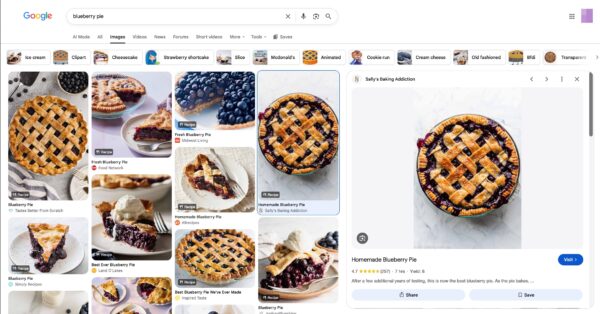
Google Lens
Google Lens enables you to search the world round you utilizing simply a picture. Level your digital camera at an object, landmark, or product, and it identifies it, finds related gadgets, and even interprets textual content in actual time. For companies, this implies your photos can drive site visitors in the event that they’re optimized proper. To indicate up nicely in Lens, use high-quality, unique photos with clear alt textual content and structured information. Google matches what it sees within the picture with what it is aware of about your web page. Unique, detailed photos with clear metadata carry out finest, so keep away from generic inventory images and concentrate on visuals that really signify your content material.

Getting your photos in AI search outcomes
AI search outcomes, like Google’s AI Overviews and AI Mode, are altering how individuals discover data. These techniques use photos to reply questions, so optimizing your visuals may also help them seem in AI-generated responses.
The excellent news is that the majority picture search engine optimization finest practices additionally apply to AI search. Clear, descriptive alt textual content helps AI perceive your photos, simply because it helps display readers. Structured information like ImageObject offers AI techniques further context to interpret and reference your visuals. Excessive-quality, unique photos additionally carry out higher, identical to they do in conventional search.
For one of the best outcomes, concentrate on the identical ways you utilize for picture search engine optimization. Use detailed alt textual content, present structured information, and guarantee your photos are high-quality and related. AI techniques usually draw on listed photos, so be certain your photos are listed in Google Pictures.
Examine Google Search Console to see how your photos carry out. In case your photos are already optimized for search engine optimization, you’re seemingly already ready for AI search. Simply hold refining these practices as AI continues to evolve.
Discovering the best picture

It’s at all times higher to make use of unique photos, like high-quality images you’ve got taken, than inventory images. Your workforce web page wants photos of your precise workforce, not this man on the best or one in all his different inventory photograph mates.
Your article wants a picture related to its topic. When you’re including a random photograph simply to get a inexperienced bullet within the Yoast search engine optimization content material evaluation, you’re doing it mistaken. The picture ought to mirror the submit’s matter or have illustrative functions inside the article. Additionally, attempt to place the picture close to the related textual content. You probably have a central picture or a picture you’re making an attempt to rank, attempt to hold that close to the highest of the web page if doable with out feeling pressured. There’s a easy picture search engine optimization motive for all of this. A picture surrounded by related textual content offers Google extra context, which helps it rank for associated queries. We’ll go into picture search engine optimization afterward.
Options
Don’t have any unique photos you need to use in your web site? There are different methods to seek out distinctive photos. Flickr: Inventive Commons and Unsplash are nice picture sources, as an illustration, as you need to use Inventive Commons photos. Keep in mind to take a look at the restrictions and attribute the unique photographer whenever you use one in all their photos. Our weblog submit offers you an outline of the place to get nice photos.
Keep away from apparent inventory images, however in the event you insist on utilizing these, choose those that look extra real. No matter you utilize, you’ll in all probability discover that photos with individuals in them are likely to appear like inventory images. Except you took the images your self, which, in our opinion, is at all times one of the best thought.
Obvious alternate options for images are illustrations or graphs. Animated GIFs deserve a point out too. They’re in every single place today.

Regardless that animated GIFs are in style, don’t overdo it. It’ll make your submit tougher to learn, because the motion of the picture distracts your readers’ consideration. Additionally, not unimportant and good to say is that they’ll decelerate your web page because the filesize will be big.
Making ready photos to be used in your article
When you’ve discovered the best picture, like a photograph, an illustration, or a chart, the following step is optimizing it on your web site. Earlier than you add your picture, there are some things you have to take into consideration:
Select the best file title
Picture search engine optimization begins with the file title. You prefer to Google to know what the picture is about with out even taking a look at it. So, use your focus keyphrase within the picture file title. It’s easy: in the event you’re writing an article on the Notre Dame and use a picture exhibiting a dawn in Paris over the Notre Dame Cathedral, the file title shouldn’t be DSC4536.jpg. A correct file title could be notre-dame-paris-sunrise.jpg. That method, the photograph’s fundamental topic (and maybe your article) is at first of the file title.
Select the best format
For photos, the proper format doesn’t exist. It is dependent upon the sort of picture and the way you need to use it. Briefly, we advocate to:
- Select WebP for bigger images or illustrations. It offers you good outcomes for colours and readability;
- use PNG if you wish to protect background transparency in your picture;
- or use AVIF, as it is going to produce high-quality outcomes with even smaller file sizes. On this case, you do want a WebP or JPEG fallback for browsers that don’t help the AVIF format. You should use instruments like Squoosh to transform your picture into the format you want.
- use SVG for logos and icons. With the assistance of CSS or JavaScript, you may handle photos in SVG format. As an example, resize them with out lack of high quality.
If you already know a big a part of your viewers makes use of particular browsers or gadgets, verify whether or not these browsers on CanIuse.com help your most popular format. While you’ve chosen the right title and format, it’s time to resize and optimize your picture!
Scale for picture search engine optimization
Loading instances affect consumer expertise and search engine optimization. The quicker the location, the simpler for customers and search engines like google to go to a web page. Pictures can add to your loading instances, particularly whenever you add an enormous picture to show it small, for instance, a 2500×1500 pixel picture displayed at 250×150 pixels dimension.
Even whether it is displayed quite a bit smaller, all the picture nonetheless needs to be loaded. So, resize the picture to the scale you need to show it. WordPress helps you do that by mechanically offering photos in a number of sizes after importing them. Sadly, that doesn’t imply the file dimension can be optimized; that’s simply the picture show dimension. So take into consideration the scale through which you add your photos.
Use responsive photos
Responsive photos assist your search engine optimization. When you’re utilizing WordPress, it’s completed mechanically by default. Pictures ought to have the srcset attribute, which makes it doable to serve a special picture per display width. That is particularly helpful for cellular gadgets.
Cut back file dimension
The subsequent step in picture search engine optimization is to make sure your scaled picture is compressed. That method, it’s served within the smallest file dimension doable. It’s good to know that WordPress does compress the photographs you add, however, sadly, this computerized compression usually isn’t sufficient to depend on it alone.
After all, you may export the picture and experiment with high quality percentages. We favor to make use of the best doable high quality photos, particularly given the recognition of high-resolution screens in cellular and desktop gadgets.
You’ll be able to nonetheless cut back the file dimension of those photos by eradicating the EXIF information, for instance. We advocate utilizing instruments like ImageOptim or web sites like Squoosh, JPEGmini, jpeg.io or Kraken.io.
While you’ve optimized your photos, you may check your web page with instruments like Google PageSpeed Insights, WebPageTest.org or Pingdom.
Enhance LCP in Core Internet Vitals
Setting width and top attributes in your photos lets the browser reserve area earlier than the picture hundreds. This prevents format shifts and improves your Core Internet Vitals, together with Largest Contentful Paint (LCP).
While you outline the width and top properties for photos in CSS, the browser can allocate the required area for the picture earlier than it’s totally loaded. This enables the browser to render the content material extra precisely and avoids sudden format shifts, which will be irritating for customers.
Listed here are some necessary advantages of doing this:
- Prevents format shifts: By setting the precise dimensions of photos, you reserve the suitable area for them. This ensures that different content material on the web page doesn’t shift or bounce round when the photographs load. Customers can begin consuming the content material with out distractions, resulting in a greater consumer expertise.
- Improves web page loading pace: When the browser is aware of the size of a picture prematurely, it may possibly allocate area for it whereas different web page components proceed to load. This helps to optimize the web page loading pace, significantly the LCP metric, as the biggest contentful factor’s area is reserved from the beginning.
- Optimizes browser rendering: Understanding the picture dimensions permits the browser to carry out higher in rendering and portray. It could allocate sources effectively and optimize the rendering pipeline, leading to a smoother and quicker looking expertise.
To specify width and top you need to use both inline types or exterior stylesheets for photos in CSS. Right here’s an instance:
img {
  width: 500px; /* Set the specified width */
  top: 300px; /* Set the specified top */
}
As a substitute of utilizing mounted pixel values, you need to use relative items like percentages or viewport-based items (e.g., vw, vh) to make the picture responsive and adapt to completely different display sizes.
It’s necessary to notice that specifying the size in CSS solely units the picture’s show dimension and never its precise file dimension. To optimize picture file sizes for quicker loading, take into account compressing and resizing photos earlier than importing them to your web site.
Obtain precedence
For a very powerful picture in your web page, the LCP picture, add fetchpriority="excessive". This tells the browser to load it first, enhancing consumer expertise and efficiency. For photos that seem additional down the web page, add decoding="async". This lets the browser decode them within the background, so that they don’t decelerate the remainder of your content material.
By specifying these components on your photos in CSS, you enhance your web site’s general efficiency, visible stability, and consumer expertise. Mix this apply with different picture search engine optimization methods, reminiscent of correct picture codecs, compression, and lazy loading, for optimum affect in your web site’s pace and Core Internet Vitals.
Including the picture to your article
Whereas Google is enhancing at recognizing what’s in a picture, you shouldn’t depend on their skills but. All of it comes right down to you offering the context for that picture, so fill in as a lot as you may! We’ll focus on how beneath.
When your picture is able to use, don’t simply throw it into your article wherever. As talked about earlier, including it near associated textual content material helps quite a bit. It makes certain the textual content is as related to the picture because the picture is to the textual content, one thing customers and Google favor.
Captions
The picture caption is the textual content that accompanies the picture on the web page. When you take a look at the photographs right here, it’s the textual content within the grey field beneath each. Why are captions necessary for picture search engine optimization? Individuals use them when scanning an article. Individuals are likely to scan headings, photos and captions as they scan an internet web page. Manner again in 1997, Jakob Nielsen wrote:
“Components that improve scanning embody headings, giant sort, daring textual content, highlighted textual content, bulleted lists, graphics, captions, matter sentences, and tables of contents.”
Do you have to add captions to each picture? No, as a result of generally photos serve different functions. Resolve whether or not you need to use yours for search engine optimization as nicely or not. It is best to solely add captions the place it might make sense to the customer for one to be there. Take into consideration the customer first, and don’t add a caption only for picture search engine optimization functions.
alt textual content
The alt textual content (or alt tag) is added to a picture, so descriptive textual content will likely be in place if the picture can’t be exhibited to the customer for any motive. That is how Wikipedia places it:
Various textual content (or alt textual content) is textual content related to a picture that serves the identical goal and conveys the identical important data because the picture. In conditions the place the picture shouldn’t be obtainable to the reader, maybe as a result of they’ve turned off photos of their net browser or are utilizing a display reader because of a visible impairment, the choice textual content ensures that no data or performance is misplaced. Absent or unhelpful different textual content is usually a supply of frustration for visually impaired customers.
The alt textual content is there to reinforce your web site’s accessibility, so make sure you add alt textual content to the photographs you utilize. Additionally, take into account together with the search engine optimization keyphrase for that web page if acceptable, however don’t stuff the alt textual content of each picture with key phrases. Most significantly, describe what’s within the image so search engines like google and other people can perceive it. The extra related data surrounding a picture, the extra search engines like google deem this picture necessary.
Nonetheless, please do not forget that not each picture wants an alt textual content. As a substitute, take into account alt textual content as part of your content material and add it the place it is sensible. As an example, if in case you have a picture purely for ornamental causes, then that picture doesn’t want an alt textual content. On this case, having an alt textual content doesn’t carry any worth to your readers. Alternatively, in the event you use a picture with a statistic, let’s say, the quantity of people that looked for ice cream final month, then this ought to be mirrored within the alt textual content. You could find steering for alt textual content on this W3’s article or try our information on optimizing alt textual content for search engines like google.
Use AI to generate alt textual content on your merchandise
Writing alt textual content for each picture can really feel like a variety of work, particularly in case your website has tons of of product photos. That’s why we constructed Yoast AI Generate for picture alt textual content. Accessible in Yoast WooCommerce search engine optimization and Yoast search engine optimization AI+, it generates related alt textual content on your product photos proper within the product editor or the Yoast search engine optimization bulk editor, primarily based in your product information. You at all times assessment and approve the recommendations, so that you keep in management.
title textual content
Some browsers present the title textual content as a ‘tooltip’ when hovering over a picture. Most desktop browsers present the title textual content as was meant. Pictures’ titles are related, and many individuals who use titles copy the alt textual content. Increasingly individuals go away them out altogether, why is that? Right here’s Mozilla’s take:
“
titlehas quite a few accessibility issues, primarily primarily based round the truth that display reader help could be very unpredictable and most browsers received’t present it until you might be hovering with a mouse (so e.g. no entry to keyboard customers).”
Together with supporting data in the primary article textual content is healthier than attaching it to the picture.
Learn extra: Learn extra about alt tag and title tag optimization »
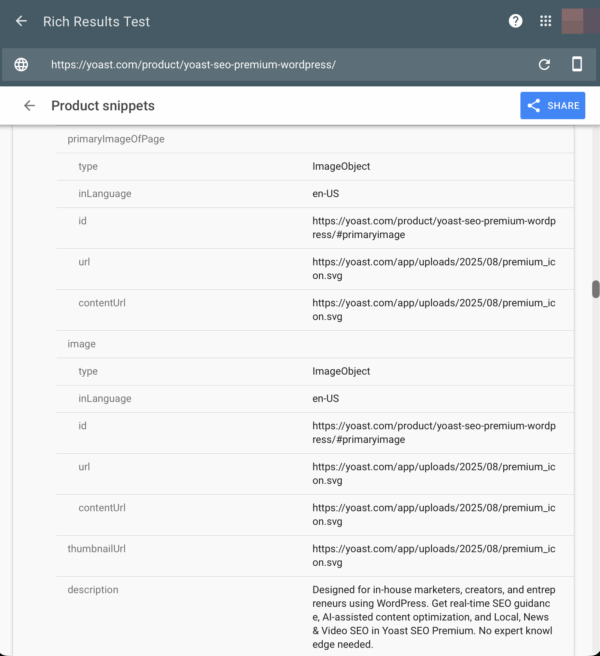
Add picture structured information
The place a naked ImageObject, and the picture property on sorts like Article or Product, tells search engines like google what a picture exhibits and the way it connects to the web page. This issues extra now that AI-driven search experiences choose and cite photos mechanically.
The excellent news for WordPress customers is that Yoast search engine optimization handles most of this mechanically: as a substitute of outputting naked picture URLs, it generates full ImageObject nodes, with captions, dimensions, and content material URLs. These are all stitched collectively right into a related site-wide schema graph, attaching your featured picture to the article schema and product photos to your WooCommerce listings. Options like picture licensing metadata (license and acquireLicensePage) aren’t included by default, however will be added by way of Yoast’s schema API filters.
Google has tips you have to comply with in order for you your photos to it to know your photos. You could find all of them in Google’s Structured Knowledge Basic Tips. Learn the developer documentation for Yoast’s use of ImageObject.
Wish to be taught extra about structured information? Enroll in our free Structured information coaching course to be taught extra about including structured information to your pages!
OpenGraph and social sharing
Earlier on, we talked about utilizing photos for social sharing. When you add the next picture tag to the part in your web page HTML like this:
That can make sure the picture is included in your share on Fb or X. OpenGraph can be used for different social media platforms like Threads, Pinterest and LinkedIn. Even productiveness software program like Slack helps OpenGraph.
Yoast search engine optimization has a Social media look part the place you may set and, within the Premium model, even preview your social posts. Be certain that to make use of a high-quality picture, like the unique picture you used within the submit, as social platforms usually use larger high quality/bigger photos.
XML picture sitemaps
As an internet developer, you may marvel about XML picture sitemaps. We’d favor to explain this as photos in XML sitemaps. Google is clear about this:
Picture sitemaps are a method of telling Google about different photos in your website, particularly people who we would not in any other case discover (reminiscent of photos your website reaches with JavaScript code). You’ll be able to create a separate picture sitemap or add picture sitemap tags to your present sitemap; both strategy is equally effective for Google. Picture sitemaps are primarily based on generic sitemaps so the basic sitemap finest practices additionally apply to picture sitemaps. We additionally advocate that you simply comply with the basic finest practices for publishing photos.
Every now and then, individuals ask us about XML picture sitemaps. We don’t generate these in our plugin however comply with Google’s recommendation and embody them within the web page or submit sitemaps. Simply scroll down in our submit sitemap and see we’ve added photos to all our posts (there’s a column only for that). Including photos to your XML sitemaps helps Google index your photos, so make certain to take action for higher picture search engine optimization.
Serving photos by way of a picture CDN
Everyone knows CDNs as one of the vital in style website pace optimizations. Some firms that present CDNs even have a particular CDN for photos. The picture CDNs are constructed round fundamental duties: to optimize your photos and get them to your customer as quick as doable. Operating a picture CDN can pace up picture supply quite a bit, as a result of the photographs are optimized mechanically and served from servers nearer to your guests
A picture CDN enables you to deal with the transformation, optimization and supply of photos. You’ll be able to decide what hundreds when and the way that ought to work. As an example, your photos will be transformed on-the-fly to trendy codecs, and serve AVIF to browsers that help it, whereas falling again to WebP after which JPEG if wanted, as a result of these codecs load a lot quicker at equal or higher high quality.
There are lots of picture CDNs to select from, like Sirv, Cloudinary and Imagekit. Additionally, platforms like Cloudflare allow you to decide easy methods to resize, reformat and serve photos.
A abstract of picture search engine optimization
Picture search engine optimization is the sum of quite a few components. With Google getting higher at recognizing components in photos on daily basis, it is sensible to verify the picture and its components contribute to consumer expertise in addition to search engine optimization. It will be silly to attempt to child Google.
Hold this stuff in thoughts when including a picture to an article:
- Use high-quality, distinctive and related photos that matches your textual content
- Decide file title on your picture
- Use trendy photos codecs like WebP and AVIF
- Be certain that picture dimensions match the picture dimension as displayed
- Use
srcsetif doable - Cut back file dimension for quicker loading
- Specify
widthandtopon your photos - Add a caption, if acceptable, for simpler scanning of the web page
- Use correct picture alt textual content. No want for a title textual content
- Add structured information to your photos
- Add OpenGraph and Twitter Card tags for the picture
- Use photos in your XML sitemaps
- Serving photos by way of a CDN
- Present all of the context you may!
In addition to contributing to search engine optimization and consumer expertise, photos may also be necessary in conversion. So don’t underestimate the significance of picture search engine optimization in your website!
Hold studying: WordPress search engine optimization: The definitive information to larger rankings for WordPress websites »