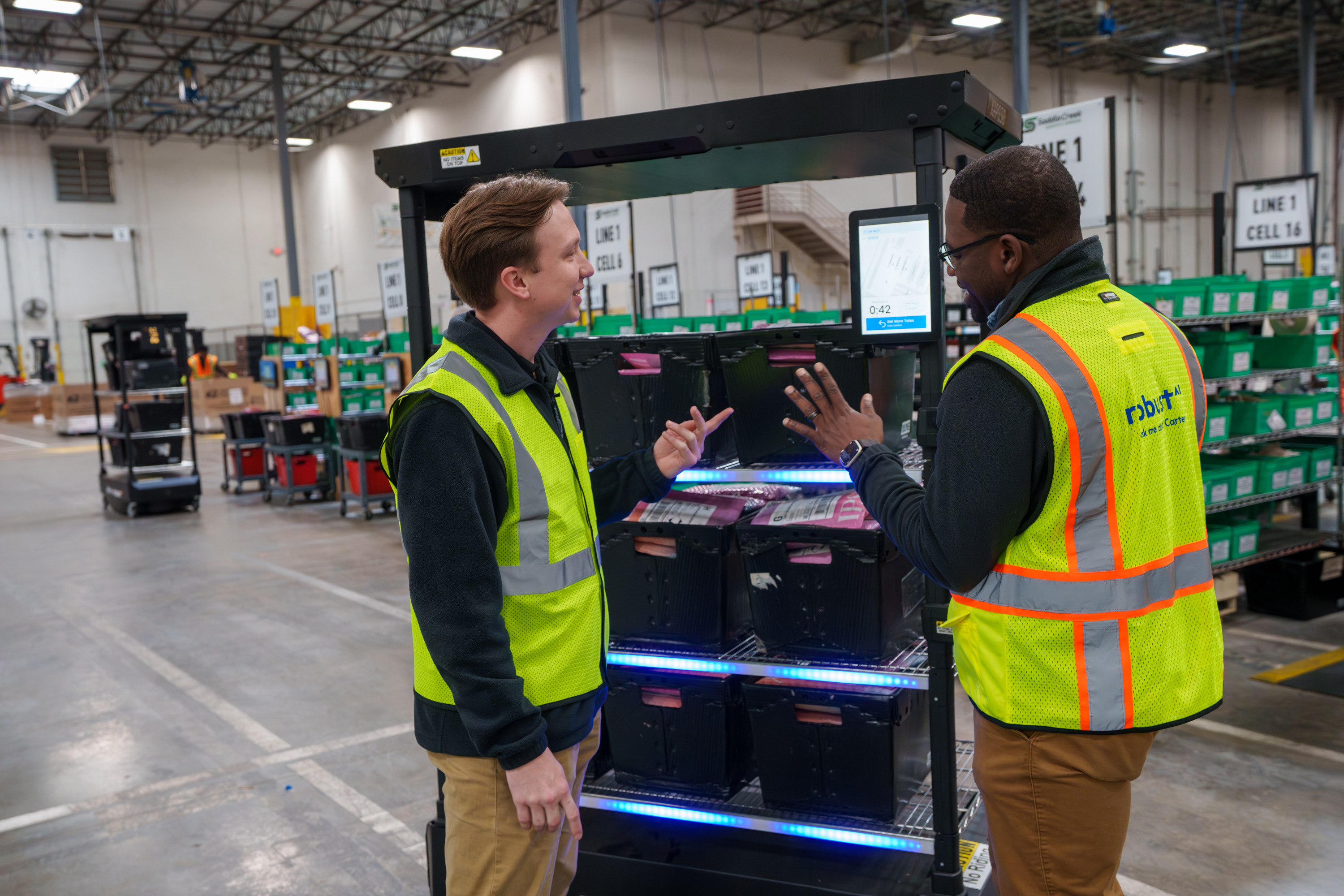
“In these environments, what actually determines success is how the general system performs,” explains Anthony Jules ’92, SM ’92, who co-founded the corporate with MIT Professor Emeritus Rodney Brooks. “The robotic does among the work, the folks do among the work, and the backend programs do among the work. It’s that mixture that determines how effectively your system performs. We imagine it’s actually essential that individuals have an acceptable degree of company and enter in order that they’re at all times shifting the system ahead.”
Collaborative robots
Brooks was a college member at MIT from 1984 till 2010 and served because the director of the Laptop Science and Synthetic Intelligence Laboratory (CSAIL) from 1997 till 2007. Whereas at MIT, he co-founded iRobot, which invented the favored Roomba vacuum and went public in 2005. Later, he co-founded the corporate Rethink Robotics, which additionally designed collaborative robots.
Jules met Brooks as a graduate pupil at CSAIL within the Nineties. The 2 by no means labored collectively, however their labs had been on the identical ground. The pair stored in contact after Jules graduated and co-founded the corporate Sapient, which went public earlier than being acquired by Publicis in 2015.
In 2019, Brooks ran into Jules at a robotics convention. He informed Jules he was considering of beginning a robotics software program firm, which he in comparison with a online game engine for coaching robots. Strong AI was based later that yr.
The Covid-19 pandemic induced the founders to shift to creating robots that would autonomously disinfect surfaces, however when it was found that Covid-19 was not transmitted through surfaces, they needed to pivot once more.
“That compelled us to determine find out how to use this know-how we had been constructing, which was actually about serving to robots perceive the world extra totally,” Jules recollects. “Lengthy story brief, I stated to Rodney, ‘I’ve an concept. You’re going to like it and also you’re going to hate it. You’re going to like it as a result of it’s fixing issues for purchasers that we’ve been listening to about, and also you’re going to hate it as a result of now we have to construct {hardware}.”
The founders had been interviewing potential clients for years by Strong AI’s early pivots. They lastly selected logistics and manufacturing because the industries to focus on early on.
“When folks take into consideration automation in factories, they consider footage of the 5 % which can be totally automated with $50 to $200 million greenback programs,” says Jules, who now serves as Strong AI’s chief innovation officer. “They don’t take into consideration the overwhelming majority of factories that aren’t automated in any respect. These factories don’t also have a conveyor belt. They aren’t going to tear every part out and change it with a $200 million system.”
Strong AI’s robots will be phased into operations as wanted and provide a number of workflows for purchasers. In a single workflow, the robotic can information human employees to particular areas to retrieve objects. In one other it may observe people to essential spots for loading. The first workflows contain Carter robots shifting issues from one place to a different, usually in massive warehouses or factories, the place they are saying human employees can stroll on common 30,000 steps a day.
“These are large areas, so an individual would possibly load the robotic with issues after which have to deliver them to a different station, however that might be 400 ft away,” says, Brooks, Strong AI’s chief know-how officer. “Now the particular person can simply say ‘achieved’ and the robotic brings it as an alternative. How the robots are built-in into the workspace is fully as much as the shopper.”
Getting work achieved
Leila Takayama, Strong AI’s vice chairman of human robotic interplay, not too long ago found a peer-reviewed examine of robots in hospitals, which had been used to do issues like collect dishes, transfer sheets, and transport different gear. The researchers found that, in lots of hospitals, a lot of robots had been turned off and towards the partitions. The nurses stated they broke.
“What actually occurred was the nurses had been dashing with a affected person on a gurney, and the robotic sees them within the hallway and stops lifeless, and so they couldn’t get the gurney round them,” Brooks says. “The robots had been getting in the way in which of nurses’ main duties.”
Strong AI’s strategy to know-how growth is to know employees’ main duties deeply and construct options that speed up these duties, whether or not a human or a robotic is doing them.
“We let people do what people are good at within the bodily world, which we’ve had tens of millions of years of evolution to get good at, and have the digital system reply to that and supply us with all of the issues that it’s good at,” Brooks explains.