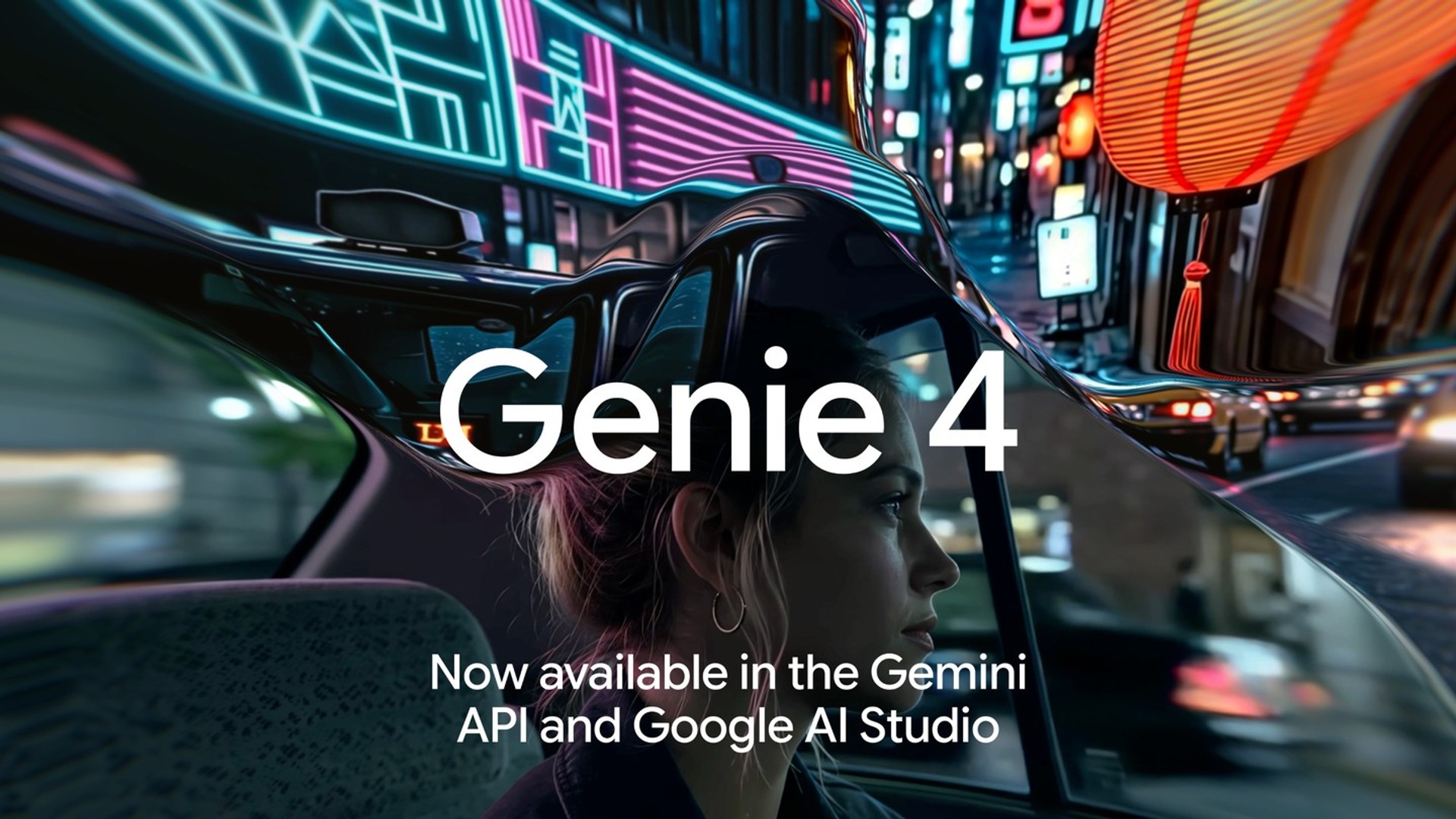
Google made Genie 4 obtainable by the Gemini API and Google AI Studio on November 19, 2026, giving builders entry to interactive worlds that reply to keyboard controls and stay textual content prompts. The mannequin generates steady 720p video at 24 frames per second with synchronized native audio.
The developer launch makes use of fashions/genie-4 on the v1beta Interactions API. A world will be seeded with textual content, a single reference picture, or each; WASD and arrow keys management motion and digicam orientation, whereas textual content occasions modify the scene or provide character dialogue. The API documentation distinguishes this responsive body rendering from offline era of a set video clip.
Google lists prototyping interactive experiences, visualizing spatial ideas, and coaching robotics and AI brokers as potential makes use of, and says each output carries imperceptible SynthID watermarking.
The API announcement follows the Mission Genie replace on November 18, 2026, which gave eligible Google AI Extremely subscribers their first entry to Genie 4 and allowed Google AI Professional members to hitch a waitlist. That subscriber launch emphasised browser-based creation, a Mission Genie agent and a group gallery; the API as a substitute provides developer classes, documentation, paid-tier pricing and utilization quotas.
Paid Classes and Billing
Genie 4 requires a paid-tier Gemini API key and isn’t provided on the free tier. Its normal pricing is $1.50 per million tokens for textual content or reference-image enter, $9 per million for textual content output, and $17.50 per million for video output with stereo audio included. At 240 video output tokens per body, or 5,760 tokens per second, the listed efficient charges are roughly $0.10 per second and $6.05 per minute. Batch API, Flex inference and Precedence inference are unsupported.
To construct a session, builders create an interplay, join over WebRTC or WebSocket, and ship one world_setup occasion earlier than steering with user_action or textual content enter occasions. Browser functions can use an ephemeral token scoped to 1 interplay, preserving the long-lived API key on the backend. WebRTC is really useful for interactive browser apps, whereas WebSocket helps Python and Node.js workflows, body seize and customized pipelines.
Closing a browser tab or detaching the native transport doesn’t instantly cease server era. Calling full() ends era and billing, whereas cancel() aborts server-side era, making express shutdown a part of price management.
Session Limits and Latency
Throughout its mannequin documentation and implementation information, Google caps classes at 120 seconds, identifies the primary 45 to 90 seconds because the strongest interval for visible coherence and object permanence, and warns that visible stability could degrade after 60 to 90 seconds.
The information describes era over a rolling temporal window with out a everlasting 3D scene. Trying away from an object for eight seconds or extra, or turning 360 levels, could make landmarks, doorways and buttons transfer or reset. For robotics or agent experiments, the generated setting subsequently can’t be assumed to supply a steady long-term map.
Output is mounted at a 16:9 facet ratio, with no portrait mode or configurable body charge, and classes are served solely from US information facilities. Google’s implementation information studies a visible response of about 0.2 to 0.5 seconds for native keyboard actions at low community latency, in contrast with roughly one to 2 seconds for mid-session textual content modifications. Spherical-trip community latency above 150 milliseconds noticeably delays keyboard steering.
Genie 4 doesn’t settle for stay microphone or webcam streams. It additionally lacks operate calling, Google Search grounding, structured outputs and the power to renew a accomplished interplay.
Utilization Quotas
Genie 4’s charge limits differ by paid challenge utilization tier:
| Utilization tier | Concurrent energetic classes | Requests per day |
|---|---|---|
| Tier 1 | 2 | 50 |
| Tier 2 | 5 | 250 |
| Tier 3 | 10 | 1,000 |
Actual-time management messages inside a session don’t eat separate per-minute or per-day request quotas.
The API makes Genie 4 a programmable setting for temporary, managed simulations relatively than a hosted persistent world. Its central constraint is continuity: functions can generate responsive scenes on demand, however the present design doesn’t present a world they’ll retain and revisit throughout accomplished classes.