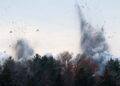
On Wednesday morning, the US Military detonated almost 5 tons of degraded lead azide exterior of Middletown, Iowa.
Environmental Safety Administration chief Lee Zeldin advised CNN shortly after the explosion that preliminary monitoring from the positioning detected no lead within the air across the web site.
However the full extent of the fallout might not be sure for a minimum of just a few days. A barrage of presidency, college, and citizen monitoring and testing tasks are underway. Air, soil, and water samples they’ve collected will decide the extent of lead publicity, if any, in Middletown and the encircling space.
The lead azide has been on the bottom close to Middletown for many years, however just lately the Military deemed it unstable and too harmful to maneuver and remediate. Poor communication between the Military and cities within the path of the fallout led to a public uproar. Whereas the federal authorities stepped up its mitigation measures—the Military dug a dam across the detonation web site, whereas NASA stepped in with analysis jets and satellites for monitoring—universities had already been swinging into motion as a result of chaotic rollout.
A number of departments on the College of Iowa kicked into gear to start to arrange air and soil monitoring stations late final week. “Initially we didn’t know that [the] EPA or Military or anyone else was going to be doing something,” says Peter Thorne, a professor of environmental well being on the college.
Scientists at Purdue College, almost 300 miles away, additionally put out a name for soil samples from Middletown.
“We realized concerning the detonation late final week; as soon as we realized of the preliminary delay in detonation date we determined to place forth the decision,” says Ellen Wells, a professor of public well being at Purdue who helps lead the testing.
Surrounding cities have been notified in late October that the Military wished to conduct pre- and post-detonation soil sampling for “an intentional, managed detonation” of a “amount of lead azide”—seemingly the one notification that many cities within the preliminary modeled path of the fallout say they acquired earlier than a press launch issued by the Military days earlier than the deliberate explosion.
The shortage of communication has, understandably, instilled plenty of public mistrust within the federal authorities, together with companies’ monitoring packages. Thorne says that efforts just like the College of Iowa’s will not be meant to displace federal monitoring, however relatively to complement and help it—and hopefully reassure the general public.
“We and the EPA are doing related publicity evaluation efforts. In the event that they agree, they can provide us some confidence,” he says. “For individuals who could be involved concerning the veracity of what the federal government tells them, if their findings are in alignment with ours, then I feel that helps quell a few of these considerations.”