Def. Not A Bubble: Torsten Slok, chief economist at Apollo World Administration, not too long ago shared a scathing notice on the true extent of the so-called “AI revolution.” The information counsel AI’s macroeconomic affect stays very restricted, which might imply we’re heading towards some actually fascinating occasions when it comes to monetary traits and international financial outcomes.
In line with Slok’s Each day Spark notice, AI has thus far delivered zero monetary payoff to company America outdoors of tech, regardless of the large sum of money and hype surrounding the newest developments in giant language mannequin analysis.
A couple of tech-related companies are seeing noticeable returns, however the overwhelming majority of firms within the S&P 500 are seeing little to point out for his or her generative AI or LLM efforts.
Slok mentioned inflation-adjusted income per employee is rising just for the Magnificent 7, the Huge Tech-heavy slice of the S&P 500 that features Nvidia, Tesla, Amazon, Microsoft, Google/Alphabet, Apple, and Meta. Revenue margins are rising for that group too. In the meantime, the “S&P 493,” as he calls the remainder of the index, is flat on each income per employee and revenue margins.
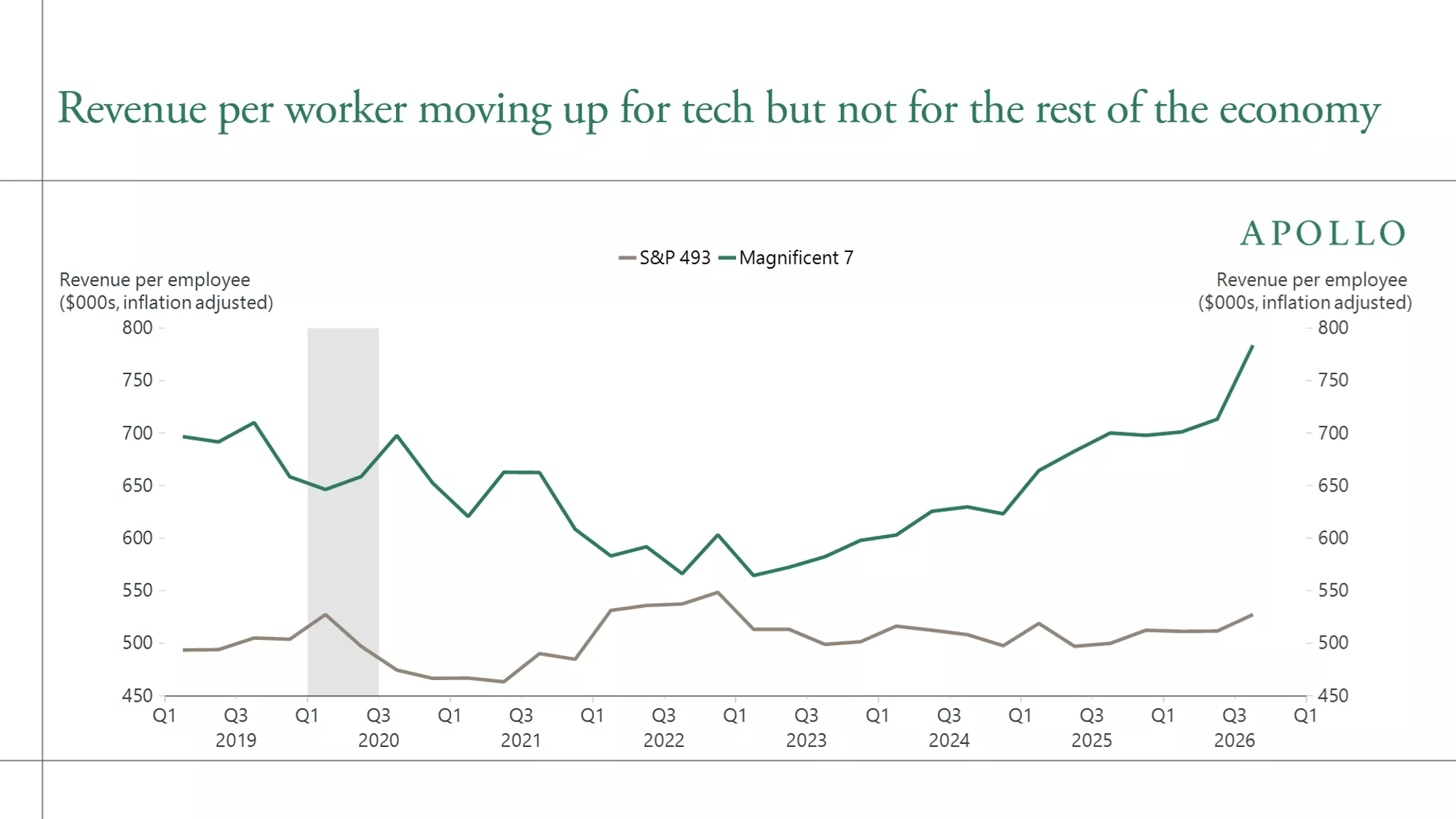
Moreover, Apollo’s economist doesn’t see any signal that AI is boosting productiveness progress. To place it merely, GenAI and LLMs are having no affect on the underside line outdoors of tech. With nothing to point out for it, mainstream S&P 500 firms are already pulling again on the large sums AI requires, treating token spending as a price that weighs on margins fairly than a possible supply of future progress.
Enterprise-backed firms maintain spending increasingly more on AI tokens, whereas mainstream organizations do not want the newest fashions, and are not prepared to pay for them. Slok mentioned that if AI stays confined to a small portion of the general economic system, its macroeconomic results can be very restricted.
AI fashions may turn out to be increasingly more commoditized, and tokens may ultimately get “low cost” sufficient for income to develop and margins to broaden. Nevertheless, Slok thinks that lofty objective could possibly be tougher to realize than it sounds. He describes AI as a robust “calculator,” however argues that companies run on common sense, not quantity crunching.

“AI doesn’t perceive accountability, belief, tradition, unwritten guidelines, moral trade-offs or equity, all of which form reputational danger and finally drive income progress and revenue margins,” Slok mentioned in his put up.
In his view, the AI story will finally be determined by the S&P 493 fairly than by the Magnificent 7’s monetary fireworks.
Slok’s agency, Apollo manages roughly $1 trillion in property, so his learn on the economic system carries weight. His outlook additionally echoes different cautionary stories, with Gartner not too long ago estimating that greater than $3.5 trillion in AI infrastructure funding might face write-downs by the tip of 2030. However not everybody shares that pessimism. Goldman Sachs economist Jan Hatzius argues that AI funding will finally repay in increased productiveness and economy-wide earnings.