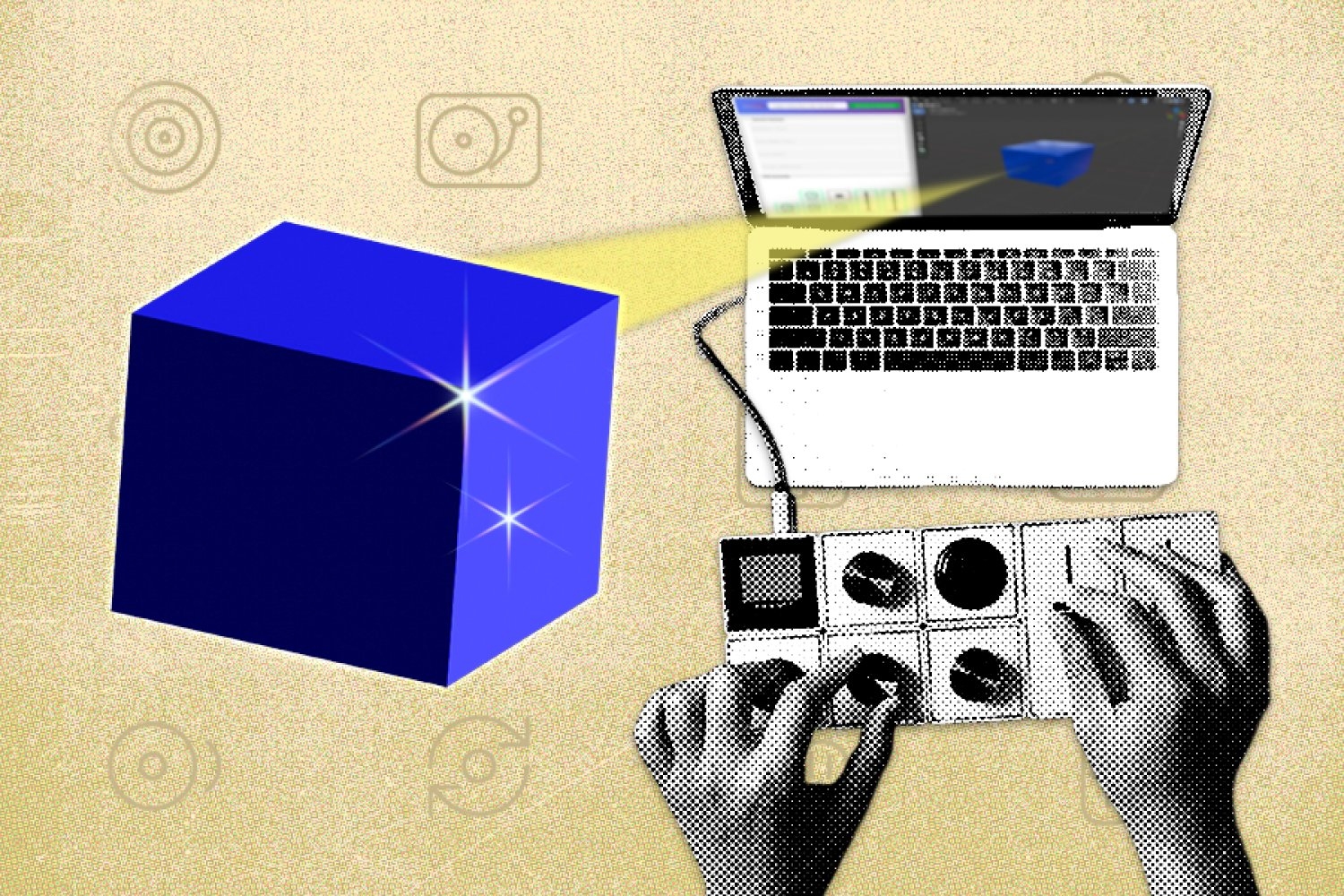
The system helped the researchers flip a typical mixer right into a photo-editing controller. That means, they might modify coloration in Adobe Lightroom, with a complementary visualization of these controls displayed on their display. The group did the identical with sound-mixing software program, in order that performers can modify their music in real-time with their very own inputs to knobs and faders.
The researchers additionally reprogrammed an easier mixer to work with the 3D modeling program Blender. Their interface included an space the place customers can kind in a immediate, and as soon as the mannequin was generated, customers might modify options like shininess on a mixer utilizing bodily controls. Inside Adobe’s Character Animator software program, TangiMap related particular expressions and actions to buttons on a management pad so customers might animate (or “puppeteer”) a cartoon character stay.
Zhu and co-author Chang Xiao, an assistant professor at Boston College, offered their device on the ACM Symposium on Consumer Interface Software program and Expertise earlier this month.
Zhu and Xiao created a customized consumer interface (UI) for every software. Whereas that provides one other layer of personalization to the inventive course of, the group is hoping to create a extra streamlined system that helps the designer to generate the UI for his or her gadget by taking an image.
The researchers are additionally contemplating the bodily features of consumer interactions. They need to use extra ergonomic gadgets and likewise make sure that TangiMap accounts for the place customers place their fingers when doing totally different duties. For instance, customers usually maintain a mixer otherwise after they’re utilizing it to make music than, say, when taking part in a online game. It’s your decision controls mapped nearer or additional aside, relying on what you’re doing.
Zhu is hoping to do a consumer examine to get extra suggestions about TangiMap, and whether or not this sort of “sensible DJing” might certainly enhance these experiences. However the dynamic reprogramming she in the end envisions is much more formidable.
“The identical means our telephones and computer systems generalize to a spread of duties, we wish different objects to be extra clever,” she says. “I wish to construct bodily objects that use an AI agent as a mind to resolve what to reprogram into. They might perceive what to remodel into, given a particular scenario.”
A chemical jar, for example, might inform you if it’s sealed appropriately when requested, and if you need to see what it’s usually used for, the container would as an alternative show that info. Whereas that sort of versatility and interactivity is a methods off, extra highly effective brokers and extra intricate fabrication pipelines might carry on a regular basis objects to life.
Their work was supported, partially, by Google’s Gemini Educational Program Award.