Beginning a web-based enterprise like Amazon sounds bold. In any case, Amazon operates one of many world’s largest ecommerce platforms, connects hundreds of thousands of consumers and sellers, and has constructed an in depth logistics community.
Nonetheless, you don’t have to recreate Amazon to construct a profitable ecommerce enterprise. It’s essential perceive its enterprise mannequin and begin at a manageable scale.
In 2027, entrepreneurs can launch a web-based retailer, create a multi-vendor market, or develop a distinct segment ecommerce platform with out investing hundreds of thousands of {dollars}.
Platforms akin to Shopify, WooCommerce, CS-Cart, and Sharetribe have made ecommerce growth extra accessible. In the meantime, AI buying assistants, together with Alexa for Procuring, ChatGPT, and Gemini, are altering how prospects uncover and evaluate merchandise.
This information explains how you can begin a web-based enterprise like Amazon, together with enterprise fashions, web site growth prices, ecommerce software program, authorized necessities, cost programs, logistics, and AI-powered buying traits.
Whether or not you’re launching in India or the USA, a very powerful choice is choosing the proper enterprise mannequin earlier than investing in expertise.
Key Takeaways
- Constructing an Amazon-style enterprise doesn’t require Amazon’s infrastructure. Begin with a distinct segment ecommerce retailer and broaden when demand is confirmed.
- A fundamental on-line retailer might price ₹30,000–₹2,00,000 ($350–$2,300), whereas market growth requires considerably extra funding.
- Shopify and WooCommerce go well with single-seller shops; devoted market software program helps a number of unbiased distributors.
- Amazon’s Alexa for Procuring and rising AI commerce platforms are altering product discovery and buying.
- Sustainable progress relies on product margins, dependable achievement, buyer belief, and efficient ecommerce advertising.
How Amazon Truly Makes Cash

Understanding the Amazon enterprise mannequin is important earlier than creating an analogous enterprise.
Amazon is greater than a web-based retail web site. It operates a number of interconnected income streams.
1. On-line Retail Gross sales
Amazon sells merchandise on to shoppers by its personal retail operations.
Income comes from merchandise gross sales, whereas profitability relies on buying prices, logistics, stock administration, and working bills.
2. Third-Celebration Market Charges
Unbiased sellers listing merchandise on Amazon’s market.
Amazon earns income by vendor providers, together with referral charges, achievement prices, and different relevant providers.
This mannequin permits Amazon to supply an infinite product choice with out proudly owning each merchandise offered.
3. Promoting Income
Manufacturers and market sellers pay to promote merchandise by Amazon Advertisements.
Sponsored Merchandise, Sponsored Manufacturers, and different promoting codecs assist companies attain buyers all through the buying journey.
Amazon reported roughly $19.6 billion in promoting providers income throughout the third quarter of 2026.
Companies serious about market promoting can discover Amazon Advertisements administration.
4. Prime Subscriptions
Amazon Prime generates subscription income whereas providing advantages akin to transport, leisure, and unique providers.
Subscriptions additionally encourage buyer loyalty and repeat purchases.
5. Amazon Net Providers
Amazon Net Providers gives cloud computing and associated infrastructure providers.
AWS is a separate enterprise from ecommerce retail, however contributes considerably to Amazon’s general monetary efficiency.
The lesson: Begin with a targeted retail or market mannequin. Promoting networks, subscriptions, and superior logistics can comply with after the enterprise establishes demand.
Retailer, Market, or Dropshipping? Select Your Mannequin
Earlier than you construct a web site like Amazon, resolve what kind of ecommerce enterprise you need to function.
| Enterprise mannequin | The way it works | Important benefit | Important problem |
|---|---|---|---|
| Single-vendor retailer | Promote merchandise from your individual stock or model | Higher operational management | Stock and achievement tasks |
| Multi-vendor market | Enable unbiased sellers to listing merchandise | Broad product choice | Vendor administration and sophisticated expertise |
| Dropshipping | Suppliers fulfill orders positioned by your retailer | Decrease upfront stock funding | Restricted management over supply and product high quality |
| Hybrid ecommerce | Mix your merchandise with authorized third-party sellers | Versatile enlargement | Extra sophisticated operations |
Which Mannequin Is Greatest for Rookies?
A single-vendor retailer is usually the best place to begin.
You management product choice, buyer expertise, pricing, and model identification.
A multi-vendor market turns into enticing if you establish a class the place unbiased sellers want entry to a shared viewers.
Dropshipping can cut back stock prices, however provider reliability and customer support stay your duty.
Keep away from launching a common market that makes an attempt to compete with Amazon throughout each class.
Begin with a particular buyer downside, product class, or underserved market.
Begin an On-line Enterprise Like Amazon: 10 Steps
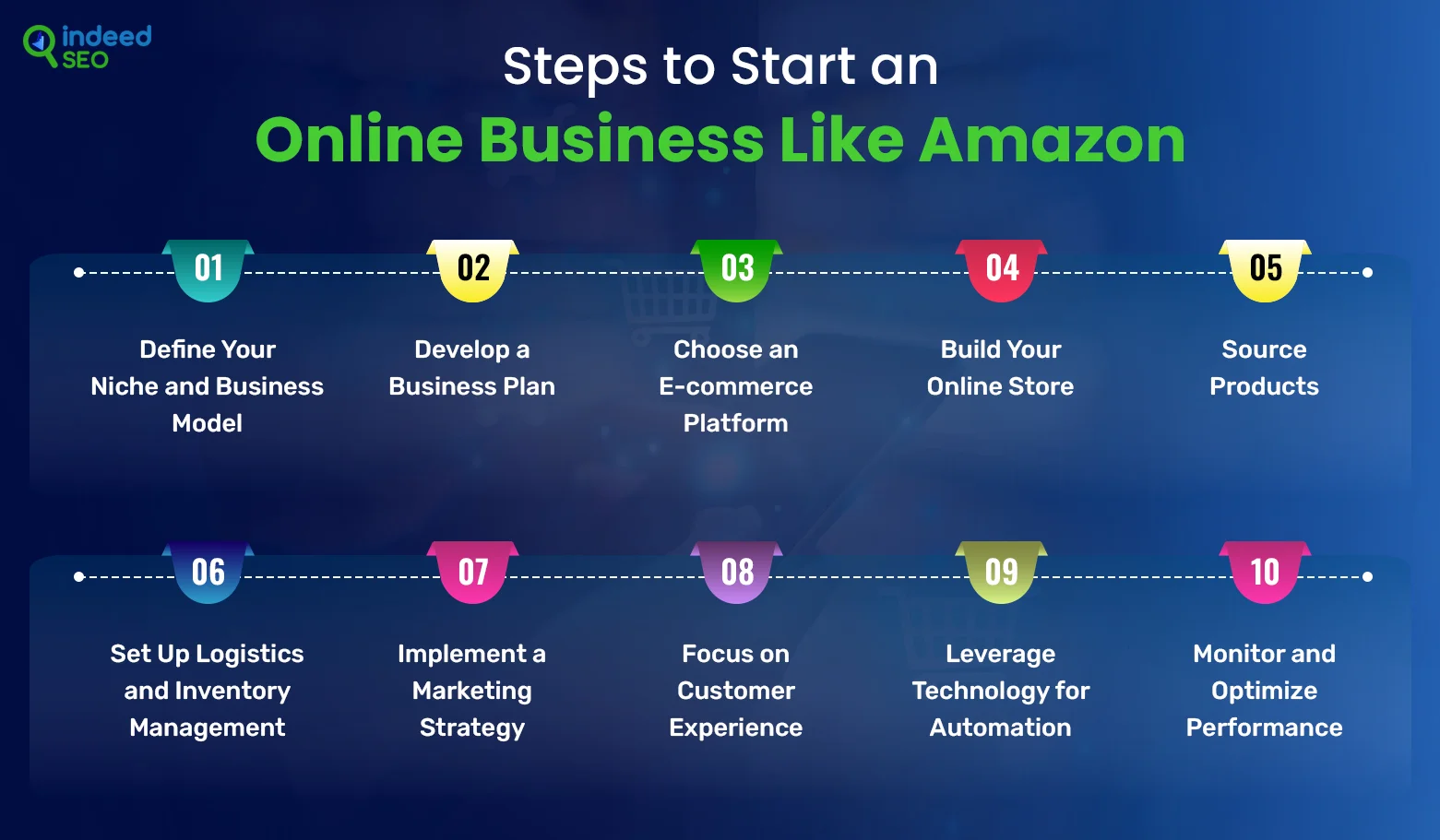
Constructing an ecommerce web site like Amazon requires greater than selecting a website title and importing merchandise.
Comply with these ten steps to ascertain a sensible basis.
1. Validate a Worthwhile Ecommerce Area of interest
Profitable ecommerce companies start with an outlined viewers.
As a substitute of making an every part retailer, analysis a selected class.
Examples embody sustainable residence merchandise, specialised pet equipment, instructional provides, or regional handmade items.
Consider:
- Buyer demand and recurring wants.
- Current rivals.
- Product acquisition prices.
- Transport necessities.
- Anticipated gross margins.
- Return and substitute charges.
Google Traits, market class studies, and buyer interviews might help establish potential alternatives.
Earlier than investing closely, take a look at demand with a restricted product vary.
2. Register Your Ecommerce Enterprise
Authorized necessities differ between India and the USA.
Beginning an ecommerce enterprise in India
Select an applicable enterprise construction, akin to a sole proprietorship, partnership, LLP, or personal restricted firm.
Relying in your actions, it’s possible you’ll require GST registration, applicable enterprise registrations, and product-specific licenses.
Market operators and sellers ought to study GST registration and tax assortment at supply necessities. Particular exemptions and circumstances might apply to eligible suppliers.
Beginning an ecommerce enterprise within the US
Widespread constructions embody sole proprietorships and LLCs.
You might want an Employer Identification Quantity, native permits, and gross sales tax registrations.
US gross sales tax obligations depend upon state guidelines and financial or bodily nexus.
Seek the advice of a certified accountant or authorized skilled earlier than launching.
3. Select the Greatest Ecommerce Platform
Choosing the proper software program is among the most vital choices when constructing a web site like Amazon.
One of the best platform relies on whether or not you desire a easy on-line retailer or a market with a number of distributors.
| Platform | Greatest suited to | Vital concerns |
|---|---|---|
| Shopify | Rookies and rising manufacturers | Subscription pricing, hosted infrastructure |
| WooCommerce | WordPress-based ecommerce | Versatile, however requires internet hosting and upkeep |
| Dokan | WordPress multi-vendor marketplaces | Requires WooCommerce and appropriate extensions |
| CS-Cart Multi-Vendor | Devoted marketplaces | Vendor instruments and licensing prices |
| Sharetribe | Service and area of interest marketplaces | Market workflows and subscription prices |
| Customized growth | Complicated enterprise marketplaces | Excessive growth and upkeep prices |
Shopify vs. WooCommerce
Shopify gives managed internet hosting, cost integrations, themes, and a longtime app ecosystem.
WooCommerce is open-source ecommerce software program constructed for WordPress. Its core platform has no licensing price, however internet hosting, extensions, safety, and growth might contain further bills.
Shopify’s US Primary plan was listed at $29 per thirty days when billed yearly in late 2026. Regional pricing and promotions differ.
For market performance, WooCommerce will be prolonged with plugins akin to Dokan.
Nonetheless, a critical multi-vendor enterprise might profit from devoted market software program.
Should you select Shopify, skilled Shopify search engine optimisation providers might help preserve search-friendly product structure as your catalog expands.
Keep away from buying an affordable Amazon clone with out evaluating safety, scalability, licensing, and long-term assist.
4. Set Up Safe Fee Techniques
Prospects count on handy and safe cost choices.
For Indian ecommerce companies, generally thought of choices embody Razorpay, PayU, UPI-based funds, and money on supply.
In the USA, cost suppliers embody Stripe, PayPal, and different service provider providers.
Earlier than deciding on a cost gateway, evaluate transaction prices, settlement durations, chargeback procedures, refund dealing with, and supported currencies.
Multi-vendor marketplaces additionally want dependable vendor settlement and fee accounting.
By no means retailer delicate card info unnecessarily. Use compliant cost infrastructure and comply with relevant knowledge safety necessities.
5. Supply Merchandise or Onboard Sellers
Product sourcing relies on your chosen enterprise mannequin.
Single-vendor shops usually work with producers, wholesalers, or direct suppliers.
Marketplaces should recruit and confirm unbiased sellers.
A dependable vendor onboarding course of ought to embody enterprise verification, product high quality expectations, fee agreements, cost phrases, and dispute-resolution procedures.
Keep away from including tons of of sellers earlier than establishing constant working requirements.
Buyer belief relies on the standard of each order, no matter which vendor fulfills it.
6. Construct Logistics and Returns Infrastructure
Environment friendly logistics are basic to ecommerce success.
In India, companies might consider providers akin to Shiprocket, Delhivery, and different supply companions.
US companies can think about third-party logistics suppliers and established service networks.
Amazon sellers may consider Success by Amazon (FBA), topic to its charges and eligibility guidelines.
Your logistics plan ought to deal with:
- Packaging and dispatch timelines.
- Supply protection.
- Cargo monitoring.
- Failed supply makes an attempt.
- Reverse logistics.
- Refund and substitute insurance policies.
Clearly talk anticipated supply instances earlier than checkout.
Quick supply guarantees imply little if your small business can not fulfill them persistently.
7. Construct the Options That Matter
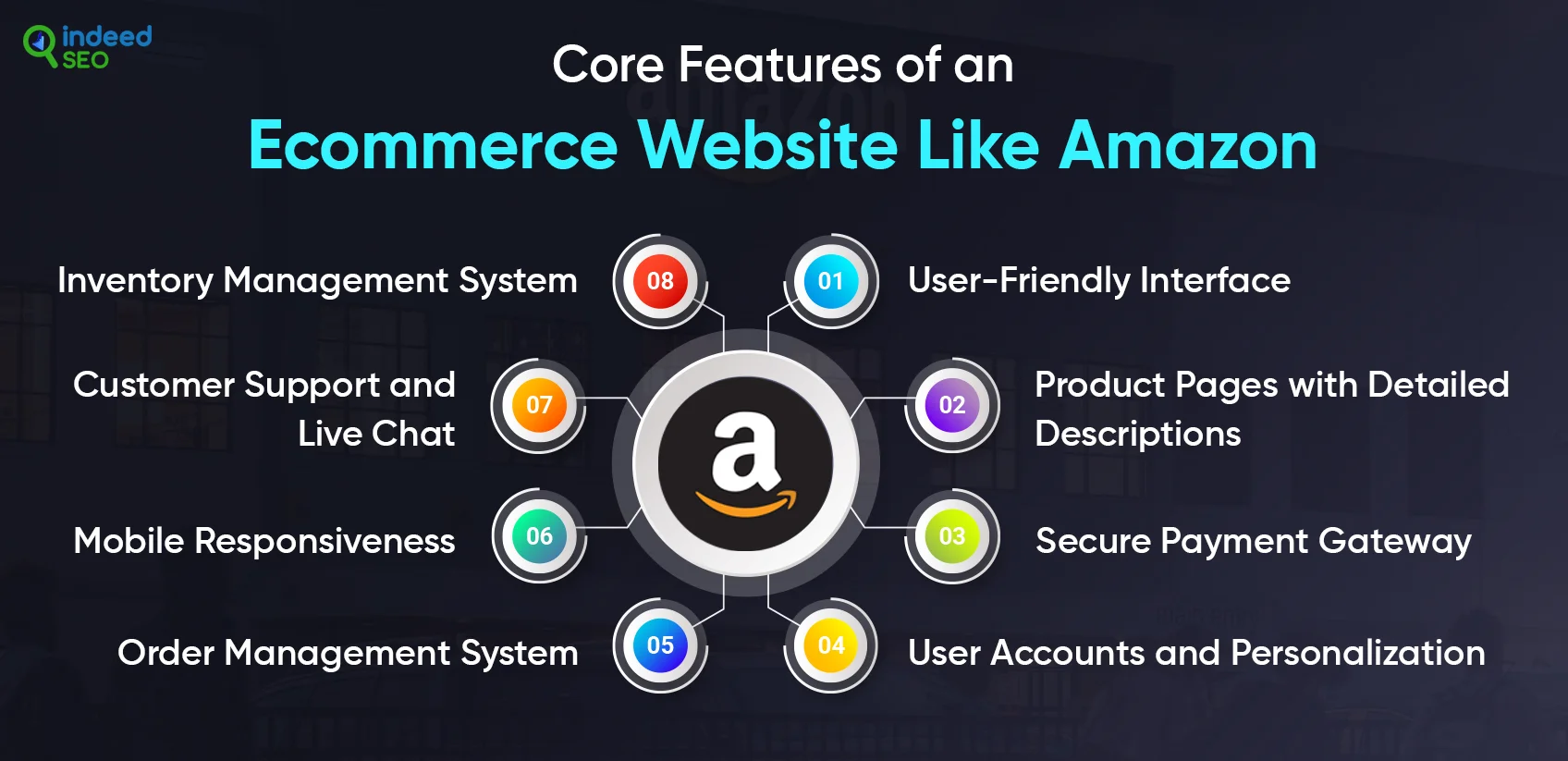
An ecommerce web site like Amazon wants purposeful buying options, not pointless complexity.
Important capabilities embody product search, class filters, product photographs, buyer accounts, safe checkout, order monitoring, opinions, and buyer assist.
For marketplaces, add vendor dashboards, stock controls, fee administration, and dispute dealing with.
Superior options akin to personalised suggestions and one-click buying will be launched later.
Cell usability is very vital as a result of many shoppers browse and buy by smartphones.
Earlier than launch, conduct a technical search engine optimisation audit to establish damaged pages, indexing points, loading issues, and cell usability errors.
8. Create an Ecommerce Advertising Technique
Even a technically wonderful on-line retailer wants a buyer acquisition technique.
Start with ecommerce search engine optimisation to enhance the discoverability of product classes and useful informational pages.
Create descriptive product titles, unique descriptions, related inner hyperlinks, and correct structured knowledge.
A longtime SEO technique can assist long-term natural visibility.
Different channels embody:
Google Procuring and search promoting: Helpful for eligible merchandise when campaigns, product feeds, and budgets are correctly managed.
Discover Google Advertisements administration for skilled marketing campaign assist.
Social media advertising: Publish helpful product demonstrations, buyer tales, and academic content material.
Constant social media advertising helps develop model recognition and buyer relationships.
Electronic mail advertising: Construct permission-based buyer lists for bulletins, helpful updates, and retention campaigns.
Measure efficiency as a substitute of investing equally throughout each advertising channel.
9. Make Your Merchandise AI-Prepared
In 2027, companies ought to put together for patrons discovering merchandise by AI buying assistants.
ChatGPT, Gemini, and Alexa for Procuring are more and more vital examples of conversational product discovery.
To enhance your web site’s readiness, preserve correct product titles, specs, pricing, availability, transport info, and return insurance policies.
Use applicable Product structured knowledge and service provider feeds the place supported.
Publish helpful solutions to product questions, together with compatibility, sizing, supplies, and meant use.
Shopify has launched agentic storefront capabilities that permit eligible merchandise to turn out to be discoverable by supported AI channels.
Nonetheless, product eligibility doesn’t assure a advice or placement.
Discover GEO advertising and reply engine optimization to know how structured info helps AI-powered discovery.
10. Monitor Your Ecommerce Efficiency
Launching a retailer is just the start.
Monitor the metrics that point out whether or not the enterprise can develop sustainably.
| Metric | What it measures |
|---|---|
| Buyer acquisition price (CAC) | Common price of buying a buyer |
| Common order worth (AOV) | Income per order |
| Gross margin | Income remaining after product prices |
| Conversion fee | Proportion of visits leading to orders |
| Repeat buy fee | Prospects returning for one more buy |
| Return fee | Orders returned or refunded |
For instance, if buying a buyer prices ₹400 however the order contributes solely ₹250 earlier than acquisition bills, the enterprise wants higher margins, retention, or acquisition effectivity.
Give attention to contribution revenue quite than income alone.
How A lot Does It Value to Construct a Web site Like Amazon?
The price to construct a web site like Amazon relies on the expertise, variety of sellers, performance, integrations, and growth strategy.
You’ll be able to launch a easy ecommerce retailer with a modest funds. Creating a complicated multi-vendor market requires considerably extra funding.
The next are illustrative planning estimates, not vendor quotations. Greenback figures are rounded equivalents utilizing roughly ₹87 per US greenback, quite than a reside alternate fee.
| Enterprise kind | Estimated price in India | Approximate USD |
|---|---|---|
| Starter ecommerce retailer | ₹30,000–₹2,00,000 | $350–$2,300 |
| Multi-vendor market | ₹3,00,000–₹15,00,000 | $3,450–$17,250 |
| Customized market platform | ₹20,00,000–₹1,00,00,000+ | $23,000–$115,000+ |
Starter Ecommerce Retailer
A fundamental retailer usually features a area, theme, internet hosting or platform subscription, cost integration, and important product pages.
It fits companies validating their first product class.
Stock, promoting, and ongoing working bills ought to be budgeted individually.
Multi-Vendor Market
A market requires vendor accounts, vendor onboarding, commissions, catalog moderation, settlement processes, and extra assist programs.
Prices rise when the mission consists of customized integrations or superior stock administration.
Customized Amazon-Type Platform
A customized market might require devoted engineering, infrastructure, safety testing, and ongoing upkeep.
The fee can enhance considerably for worldwide operations, excessive transaction volumes, and sophisticated achievement programs.
Vital: Web site growth price will not be the identical as complete enterprise funding. Embrace stock, staffing, logistics, authorized compliance, cost charges, and advertising when getting ready your funds.
What’s Altering for Amazon-Type Companies in 2027?
AI buying, automated buying, conversational promoting, and modifications in market charges are reshaping ecommerce.
Listed below are 5 developments price monitoring.
1. Alexa for Procuring Is Altering Product Discovery
Amazon renamed its Rufus buying assistant Alexa for Procuring in Might 2026.
The assistant helps buyers analysis merchandise, evaluate alternate options, discover pricing info, and obtain personalised strategies.
Moderately than looking for a particular product title, prospects can ask questions akin to:
“What is an appropriate workplace chair for a small house?”
AI-powered suggestions can think about product info, buyer preferences, and accessible buying knowledge.
For companies, this reinforces the significance of correct product descriptions, real opinions, and full product info.
Nonetheless, advice conduct varies by market and buyer context.
2. Amazon Purchase for Me Introduces Agentic Commerce
Amazon’s Purchase for Me performance permits eligible US buyers to buy chosen merchandise from exterior service provider web sites by Amazon’s buying expertise.
The characteristic varieties a part of Amazon’s broader effort to assist prospects uncover merchandise exterior its personal market.
That is an instance of agentic commerce, the place an AI-enabled buying system assists with actions past product analysis.
Unbiased shops ought to monitor eligibility and service provider necessities.
Being discoverable by exterior buying experiences doesn’t assure inclusion in Purchase for Me.
Companies also can discover ChatGPT search engine optimisation to know different AI product discovery environments.
3. AI Conversations Are Changing into Promoting Surfaces
Amazon launched Sponsored Merchandise prompts and Sponsored Manufacturers prompts to deliver product-related info into AI-assisted buying experiences.
In September 2026, Amazon introduced Branded Conversations, scheduled to launch in the USA in January 2027.
The characteristic is designed to permit buyers to enter multi-turn, brand-informed conversations from eligible Sponsored Manufacturers ads.
Availability is initially restricted to eligible US advertisers.
Companies evaluating these codecs ought to perceive reporting, marketing campaign eligibility, and promoting prices.
See Amazon Advertisements administration and this information to Amazon PPC prices.
4. Amazon India Vendor Charges Proceed to Change
Amazon India expanded zero-referral-fee eligibility to numerous merchandise priced at ₹1,000 or beneath.
Nonetheless, this doesn’t imply each product or transaction is fee-free.
Closing charges, transport prices, achievement charges, and different relevant prices can nonetheless have an effect on profitability.
Amazon additionally up to date sure closing charges efficient September 7, 2026.
Earlier than itemizing merchandise, use the official Amazon India vendor charges web page and calculate category-specific prices.
Assessment the price schedule once more earlier than making 2027 pricing choices.
5. Belief and Privateness Can Differentiate Unbiased Shops
Unbiased ecommerce companies can construct belief by clear insurance policies and personalised service.
Clear pricing, genuine opinions, responsive buyer assist, and simple returns cut back uncertainty.
Defend buyer info and keep away from exaggerated product claims.
Skilled on-line status administration providers can assist broader model belief initiatives.
Construct Your Personal Website, Promote on Amazon, or Each?
Selecting between an unbiased retailer and Amazon’s market relies on your objectives.
| Issue | Personal ecommerce web site | Amazon market | Purchase for Me eligibility |
|---|---|---|---|
| Model management | Excessive | Restricted by Amazon insurance policies | Service provider retains its personal storefront |
| Buyer relationship | Direct | Platform-mediated | Is dependent upon the transaction expertise |
| Preliminary growth | Required | Normally minimal | Current service provider web site wanted |
| Buyer acquisition | Your duty | Entry to market buyers | Potential AI-assisted discovery |
| Charges | Platform, funds, logistics | Vendor and achievement prices | Eligibility and relevant phrases |
| Availability | Broad | Supported vendor markets | Chosen eligible experiences |
For a lot of companies, a hybrid technique is sensible.
Promote by Amazon the place commercially applicable whereas creating an unbiased web site that helps your model and buyer relationships.
This reduces dependence on a single channel.
Amazon’s promoting options might assist eligible market campaigns, whereas your individual retailer provides you higher management over web site design, buyer communications, and long-term model growth.
Your First 90 Days: Ecommerce Launch Plan
A practical launch roadmap helps stop pointless spending.
| Timeline | Important priorities |
|---|---|
| Days 1–15 | Analysis the area of interest, prospects, merchandise, and competitors |
| Days 16–30 | Register the enterprise, consider suppliers, select a platform |
| Days 31–45 | Construct the shop, combine funds, configure transport |
| Days 46–60 | Add merchandise, take a look at checkout, finalize insurance policies |
| Days 61–75 | Launch advertising, enhance product pages, gather suggestions |
| Days 76–90 | Assessment gross sales, margins, returns, and buyer acquisition |
By day 90, intention to know your working prices and whether or not prospects genuinely worth your merchandise.
Don’t broaden your catalog just because the expertise permits it.
Conclusion: Construct a Enterprise That Can Develop Past Its First Retailer
You don’t want Amazon’s monumental infrastructure to begin a profitable ecommerce enterprise in 2027.
Start with a worthwhile area of interest, select applicable expertise, construct dependable achievement processes, and develop buyer belief.
Because the enterprise grows, you may broaden from a single-vendor retailer right into a multi-vendor market whereas getting ready for AI-powered commerce.
Whether or not you want ecommerce search engine optimisation, paid promoting, market optimization, or AI search visibility, a structured advertising technique can assist sustainable progress.
Able to develop your ecommerce enterprise? Request a session to debate your web site, advertising, and progress necessities.

Continuously Requested Questions
1. How a lot does it price to construct a web site like Amazon?
A fundamental ecommerce web site in India might price roughly ₹30,000–₹2,00,000. A multi-vendor market might require ₹3 lakh–₹15 lakh, whereas customized market growth can exceed ₹20 lakh. Prices differ in keeping with design, expertise, integrations, safety, and ongoing upkeep.
2. Can I begin a enterprise like Amazon with little cash?
Sure. You’ll be able to start with a small area of interest retailer utilizing hosted ecommerce software program or an present market. Decrease pointless customized growth, validate buyer demand, and reinvest earnings step by step. Stock, transport, advertising, and operational prices nonetheless require cautious budgeting.
3. Which platform is greatest for a multi-vendor market like Amazon?
Dokan, CS-Cart Multi-Vendor, and Sharetribe are choices price evaluating. Shopify and WooCommerce are sometimes less complicated for single-vendor ecommerce. Your best option relies on vendor administration, cost splitting, fee guidelines, scalability, and your growth funds.
4. How lengthy does it take to construct an ecommerce web site like Amazon?
A fundamental ecommerce retailer might take a number of weeks, relying on product readiness and integrations. A extra advanced market might require a number of months. Customized platforms can take significantly longer due to vendor workflows, safety, logistics integrations, and intensive testing.
5. Do I want GST to promote on-line in India?
GST necessities depend upon the enterprise mannequin, turnover, location, merchandise, and whether or not gross sales happen by an ecommerce operator. Market operators face further obligations. Sure exemptions might apply to eligible suppliers. Seek the advice of a tax skilled earlier than launching.
6. Is it higher to promote on Amazon or my very own web site?
Amazon gives entry to established market infrastructure, whereas an unbiased web site gives higher management over branding and buyer relationships. Many companies use each channels to diversify income and cut back dependence on a single platform.
7. What Is Amazon Alexa for Procuring, previously Rufus?
Alexa for Procuring is Amazon’s AI-powered buying assistant, previously referred to as Rufus. It helps prospects analysis merchandise, evaluate choices, and make buying choices. Correct listings and product info are vital, however no enterprise can assure an AI advice.
8. What’s Amazon Purchase for Me?
Purchase for Me is an Amazon buying characteristic that may assist eligible US prospects buy chosen merchandise from exterior service provider web sites. Availability is restricted and topic to Amazon’s eligibility guidelines. Retailer inclusion shouldn’t be assumed.
9. Did Amazon India take away referral charges in 2026?
Amazon India expanded zero-referral-fee eligibility for quite a few merchandise priced at ₹1,000 or beneath. Nonetheless, eligible classes and value circumstances matter, and sellers should still incur closing, transport, achievement, and different prices. At all times confirm the present price schedule.
10. How do I get my merchandise really useful by ChatGPT or Gemini?
Keep correct product info, legitimate structured knowledge, up to date stock, aggressive and clear pricing, and clear service provider insurance policies. Use supported product feeds and commerce integrations the place accessible. These practices enhance technical readiness however don’t assure AI visibility.