AI is now part of each vendor’s software program pitch. In the event you’re the one shopping for, you wish to know whether or not it really works, and the perfect reply comes from individuals who’ve already used it. TechSparks 2026, YourStory’s startup and expertise summit in Bengaluru from October 13 to fifteen, introduced collectively builders discussing how AI earns purchaser belief. G2’s proprietary assessment knowledge gives a technique to examine these occasion views with how patrons describe AI after utilizing it
Two areas outlined the AI dialog at TechSparks: Finance and Accounting, and Constructing Design. In finance, audio system from Pine Labs, Sahi and Intuit all talked about checks: what an AI is allowed to do, what document it leaves, and who solutions for the outcome. In constructing design, two founders demonstrated an AI software that generated an entire constructing mannequin from a single immediate.
These discussions prompted an evaluation of two G2 classes: accounting software program and constructing design software program.
The large query: What proof can patrons discover that AI software program delivers on its guarantees, and the way does that proof differ by software program class?
I can’t measure belief immediately, however what I can see is how builders say they earn it, and the way reviewers discuss AI after utilizing it.
The brief reply? It depends upon the form of software program and the distinction speaks volumes. In finance, builders emphasize on limits, information, and who solutions for the outcome. That is additionally verified from G2 assessment knowledge – accounting reviewers point out AI more and more 12 months after 12 months and are largely optimistic about it. In constructing design, nonetheless, a founder can now sort one request and get a constructing mannequin, however reviewers barely point out AI but, and those who query it need extra of it.
What does it take to construct belief in AI in finance? insights from TechSparks
I attended three finance classes, and so they had rather a lot in frequent.
Pine Labs, a funds firm, confirmed an AI agent that takes a cyber-fraud grievance from consumption to closure. It reads the grievance, matches the transaction, sends it to the proper crew, and recordsdata the response on a authorities portal. An individual stays in charge of the password and the one-time code. Each determination opens right into a 15-step hint, a document of every step with the proof and the arrogance behind it, and a kill change is all the time inside attain.
On the occasion, the corporate’s CTO shared that constructing an agent is the simple half – The laborious elements are connecting instruments, steady monitoring and checks, and deciding when and the place an individual must step in and the place the kill change goes. Every agent additionally will get a signed checklist of what it must do, and if it goes past the checklist, it may be shut down. .
Sahi, an investing app, introduced that concept of management into its AI assistant’s design. Earlier than the assistant reads something about you, it asks for permission on a display that claims what it’ll learn, why, and for the way lengthy. The assistant focuses on explaining relatively than providing funding ideas, and it declines requests when applicable
Its guidelines slide ended with one line: “The system experiences the information. The individual owns the decision.”
At Intuit, a principal AI scientist pointed to a problem that has barely modified: knowledge high quality. Dependable AI nonetheless depends upon the data behind it..
All three classes in finance got here again to the identical outcomes: limits on what the AI can do, a document of what it did, and an individual who solutions for it. The discussions coated finance broadly, whereas my G2 evaluation focuses on accounting software program. The connection is between the concepts mentioned onstage and reviewers’ experiences, relatively than a direct comparability of merchandise.
What do accounting reviewers say about AI?
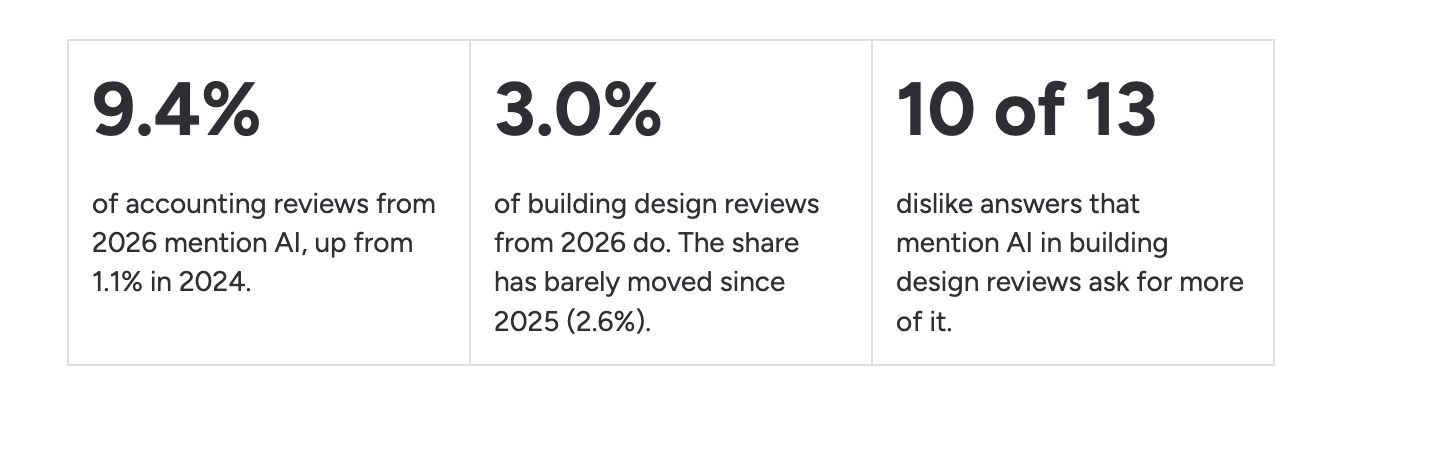
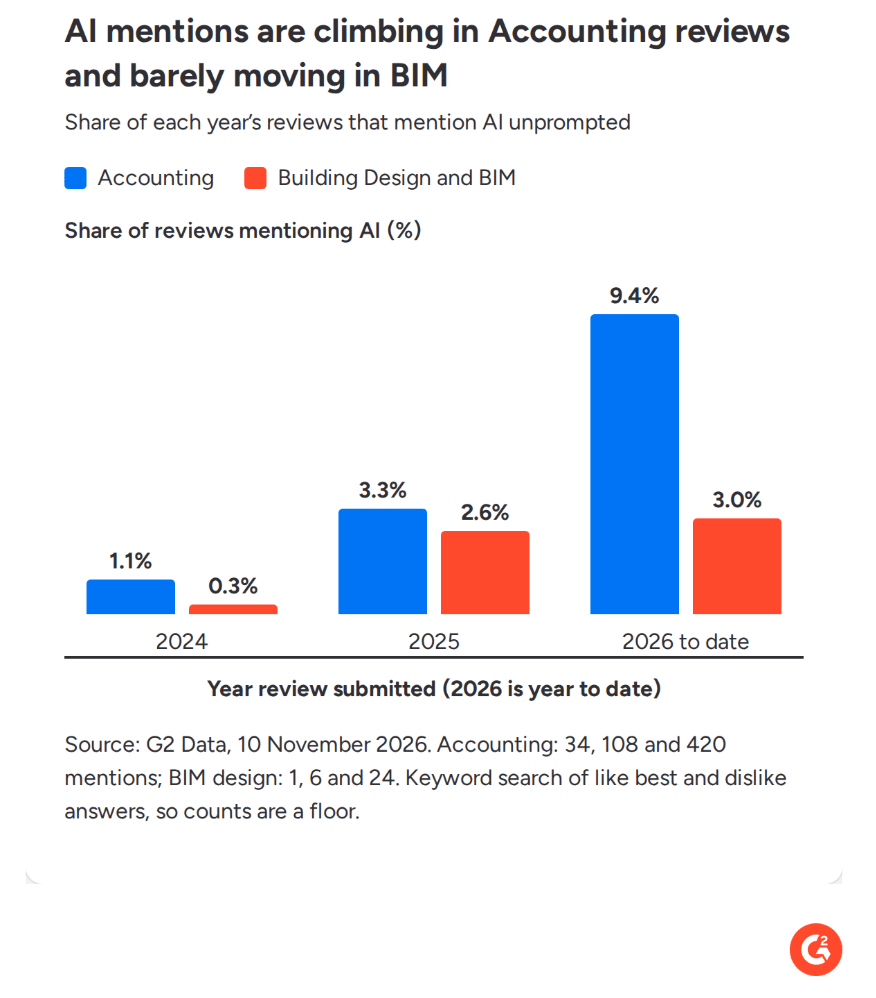
Based on G2 Information, accounting software program has 31,600+ permitted evaluations, and in 2024, 1.1% of them talked about AI. In 2025, it was 3.3%. In 2026 to this point it’s 9.4%, greater than eight occasions the 2024 share. The fact is obvious – Reviewers are speaking about AI, and it is rising yearly.
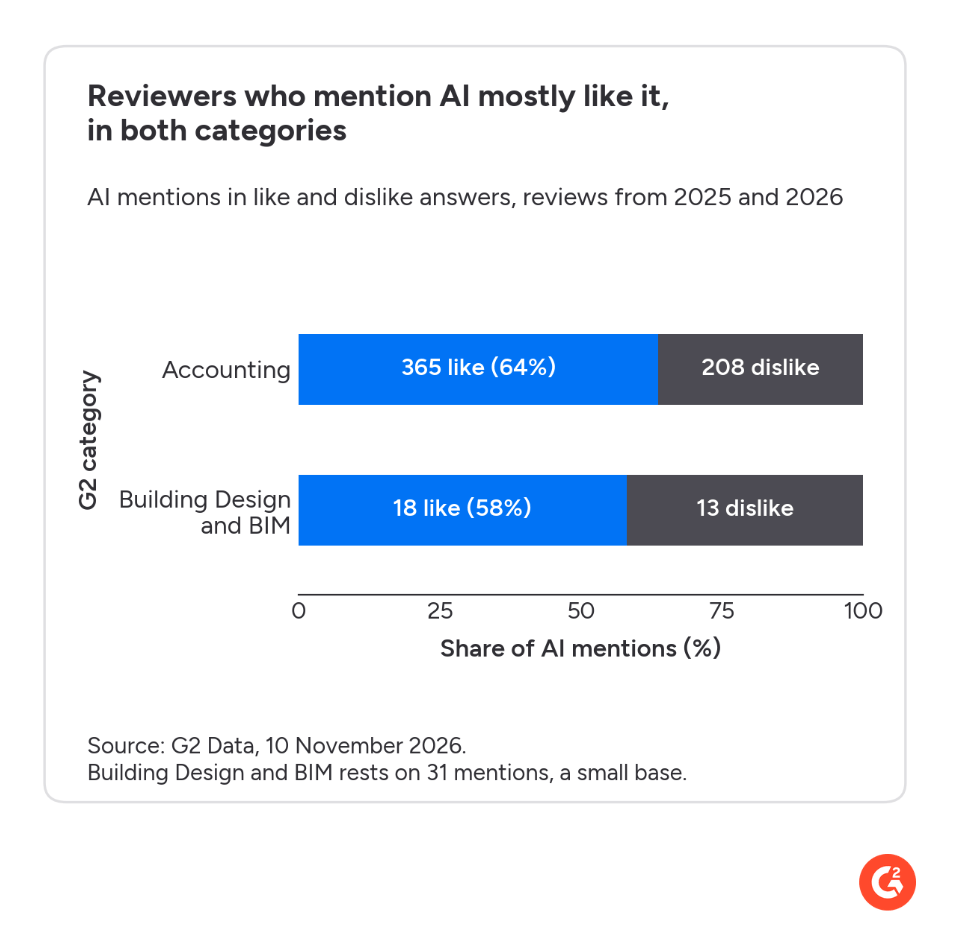
When accounting reviewers from 2025 and 2026 deliver up AI, they largely say one thing good: about 64% of these mentions are within the “like” solutions and 36% within the “dislike” solutions. Constructing design, which I cowl within the subsequent part, appears related at 58% and 42%.
Between the TechSparks occasion and my evaluation of G2 knowledge, what stood out to me was the hole. The builders at TechSparks stored coming again to the document behind a solution: permissions, traces, logs. Reviewers write in regards to the reply itself. Accuracy comes up in 4.9% of accounting evaluations from 2025 and 2026, and audit trails in 1.2%, a few quarter as usually. These counts cowl all accounting evaluations, not solely those that point out AI. One attainable rationalization is that audit trails obtain much less consideration in on a regular basis use and solely turn into seen when somebody must confirm what occurred.
What did TechSparks reveal about AI in constructing design?
TechSparks revealed that AI in constructing design is forward of the assessment proof — distributors are demonstrating capabilities that patrons haven’t but written about. The session showcased BRIXX, an AI-native structure, engineering, and building (AEC) platform developed by Tagbin. The founders began their session with a well-known set of issues that corporations face:
- Designs occur in flat 2D recordsdata, so each change will get redrawn by hand
- The methods used for design, price, and schedule don’t speak to one another
- Each plot has its personal rulebook, as a result of constructing guidelines differ by state and metropolis Then got here the demo. The presenter typed one request to recreate a widely known tower. The software researched the constructing, produced a technical drawing (CAD) and structure, after which a BIM mannequin. It included the construction, with its columns and beams, and the work beneath floor, together with excavation that accounts for the water desk and the power of the soil. For cooling, it positioned two air chillers based mostly on the tower’s hundreds, which means what it has to hold and deal with, and routed the pipes down shafts. The presenter mentioned planning, routing, and avoiding clashes between methods, resembling a pipe operating by means of a beam, can take months and was carried out with a single command.
Their slide described the software this manner: “Not a alternative. A connecting layer.” It really works alongside design instruments resembling AutoCAD, Revit, and Snaptrude, and designers hold the instruments they use. What they confirmed was compelling, nevertheless it was nonetheless a demo. The capabilities described right here replicate what the founders introduced and claimed; I haven’t seen the software used on an actual challenge.

Demo 3D Tower mannequin
What do constructing design (BIM) reviewers say about AI?
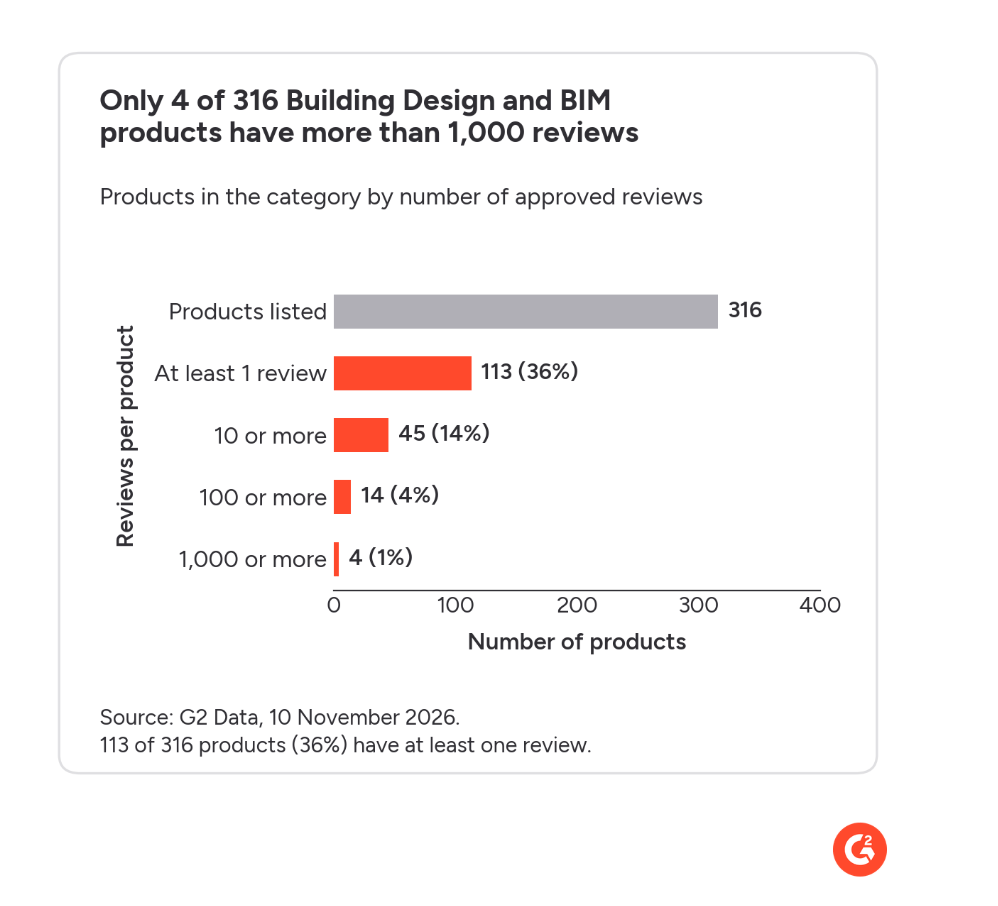
Constructing design reviewers not often point out AI — solely 3.0% of 2026 evaluations do, and those that criticize it need extra of it, not much less. Only a few do. On G2, the class is Constructing Design and Constructing Data Modeling (BIM). It has 5,104 permitted evaluations throughout 316 merchandise. G2 describes it as design software program for structure and building, with 2D or 3D instruments, a shared constructing mannequin, and methods to simulate and assess a constructing’s anticipated efficiency earlier than building.
Amongst constructing design evaluations, the share that mentions AI rose from 0.3% in 2024 to 2.6% in 2025 and three.0% in 2026 to this point. Critiques greater than tripled between 2025 and 2026, however the share barely modified. Reviewers are writing about these instruments, simply not in regards to the AI in them but.
The few who do are pretty optimistic: 18 mentions within the “like” solutions and 13 within the “dislike” solutions. However the criticism tells a extra attention-grabbing story. Of the 13 “dislike” responses I learn, ten requested for extra AI functionality. One Navisworks reviewer mentioned the development project-review software could be “on one other degree if it had AI brokers.” For these reviewers, the frustration shouldn’t be in regards to the AI, however the lack of it. With simply 13 responses and a classification based mostly alone studying, this means a sample relatively than a exact measure of purchaser sentiment.
How simple is every form of software program to make use of?
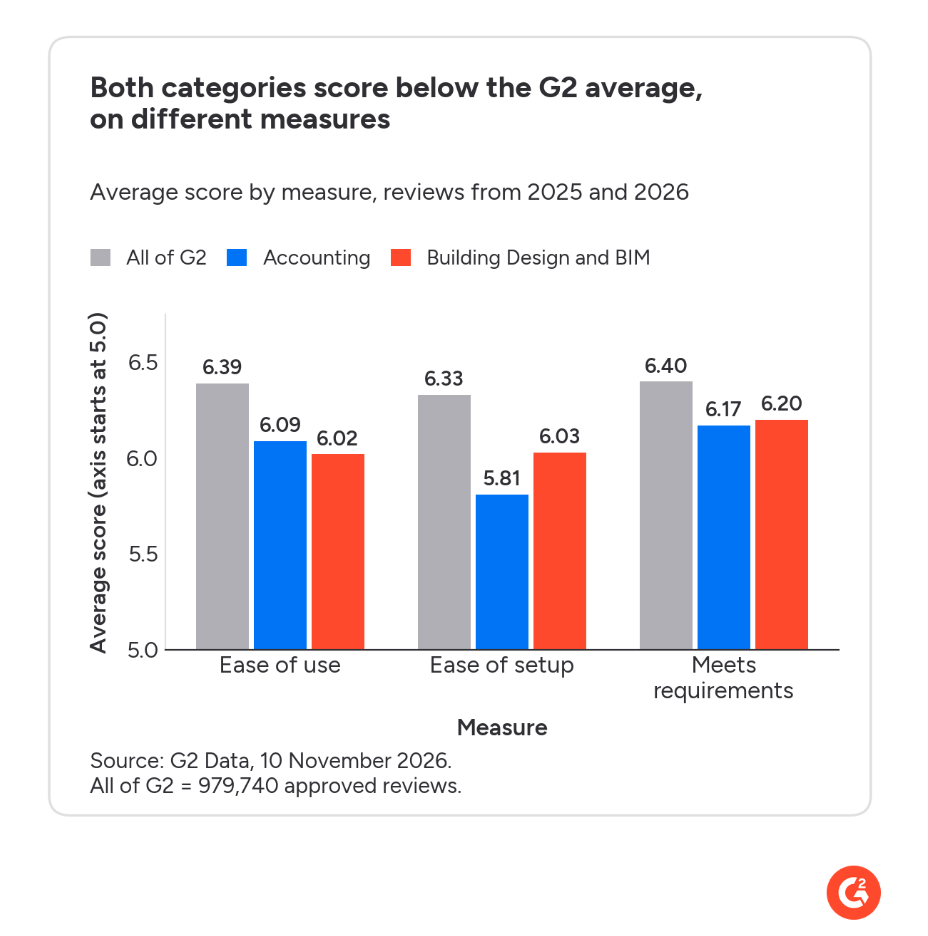
Neither is simple. I in contrast evaluations from 2025 and 2026 with all permitted G2 evaluations from the identical interval. Each classes rating beneath the G2 common on ease of use, ease of setup, and whether or not the product meets necessities. On G2’s ranking scale, the place increased is best, accounting’s greatest hole is setup (5.81 towards 6.33). Constructing design’s greatest hole is ease of use (6.02 towards 6.39). The gaps are small, about 0.3 to 0.5, suggesting each classes are barely tougher to make use of than common, not considerably so.
That matches the BRIXX founders’ level that BIM by no means acquired simple. The evaluations can not inform us whether or not an AI software fixes that. It’s the query a purchaser ought to check.
What do the occasions and the evaluations inform patrons?
In finance, builders speak in regards to the document behind a solution and reviewers speak in regards to the reply. A purchaser can ask for each: the proof and the document.
In constructing design, the demo is forward of the assessment proof. The founders confirmed a software performing duties in a single command that they mentioned might take months, but few G2 reviewers point out AI. With restricted impartial suggestions to attract on, patrons want to check these claims on their very own initiatives.
What do you have to ask earlier than trusting AI in both form of software program?
Ask about limits, information, and accountability. These are the three issues finance AI builders at TechSparks and G2 reviewers constantly level to.
In accounting software program
- What’s the AI allowed to do, and what occurs if it goes past that?
- Can I see the proof and the arrogance behind every reply, and export a document for an audit?
- The place does an individual step in, and is there a technique to cease it?
In constructing design software program
- Who’s accountable for the structural and building-services design it generates, and does a licensed engineer assessment it?
- How does it deal with a messy actual challenge, not only a well-documented landmark?
- How does it sustain with native constructing guidelines, which differ by state and metropolis?
My verdict: proof beats guarantees
My essential takeaway from TechSparks is that belief wants totally different sorts of proof. The finance builders I heard from showcased boundaries: what the AI can do, what document it leaves, and who solutions for it. The constructing design founders however confirmed a demo and informed us what it may well do. The subsequent step for them is the software acting on an actual challenge.
G2 evaluations present the place patrons are at this time and add to those views. In accounting, 9.4% of this 12 months’s evaluations point out AI, most of them optimistic, and accuracy comes up much more usually than audit trails. In constructing design, solely 3.0% point out it, and those who criticise it need extra of it. The proof is deeper in a single class and nonetheless forming within the different.
If you’re shopping for, ask to see the boundaries, the document, and who’s accountable when one thing goes improper. The place assessment proof is proscribed, check the software program by yourself challenge. For builders, the chance is to make these solutions as seen because the capabilities themselves.
Often requested questions (FAQs) about AI belief in accounting and constructing design software program
Q1. How do I consider AI claims from a software program vendor earlier than shopping for?
Ask distributors to indicate limits, information, and accountability. In accounting software program, ask what the AI can and can’t do, what hint it leaves behind, and who’s chargeable for the outcome. In constructing design, ask the way it handles an actual challenge with messy knowledge and native constructing guidelines, and who indicators off on the structural output.
Q2. What’s BIM?
Constructing data modeling is a manner of designing a constructing as one detailed 3D mannequin. Each half carries its personal data, resembling its power and fireplace ranking.
Q3. Why achieve this few constructing design evaluations point out AI?
Solely 3.0% of constructing design evaluations from 2026 point out AI, in comparison with 9.4% in accounting. Evaluation quantity greater than tripled in 2026 but the AI point out share barely moved, suggesting patrons are evaluating these instruments on conventional standards, ease of use, integration, and output high quality, relatively than AI particularly. The patrons who do point out AI largely need extra of it, not much less.
This fall. What does the TechSparks proof inform patrons that G2 evaluations don’t?
TechSparks confirmed distributors demonstrating AI capabilities in constructing design that patrons haven’t but written about in G2 evaluations. The occasion proof is forward of the assessment proof. Consumers evaluating these instruments ought to check them on actual initiatives relatively than relying solely on peer evaluations at this stage.
For a more in-depth take a look at what patrons anticipate from AI brokers and the way distributors can earn their belief, discover G2’s 2026 AI Brokers Report by Tim Sanders.