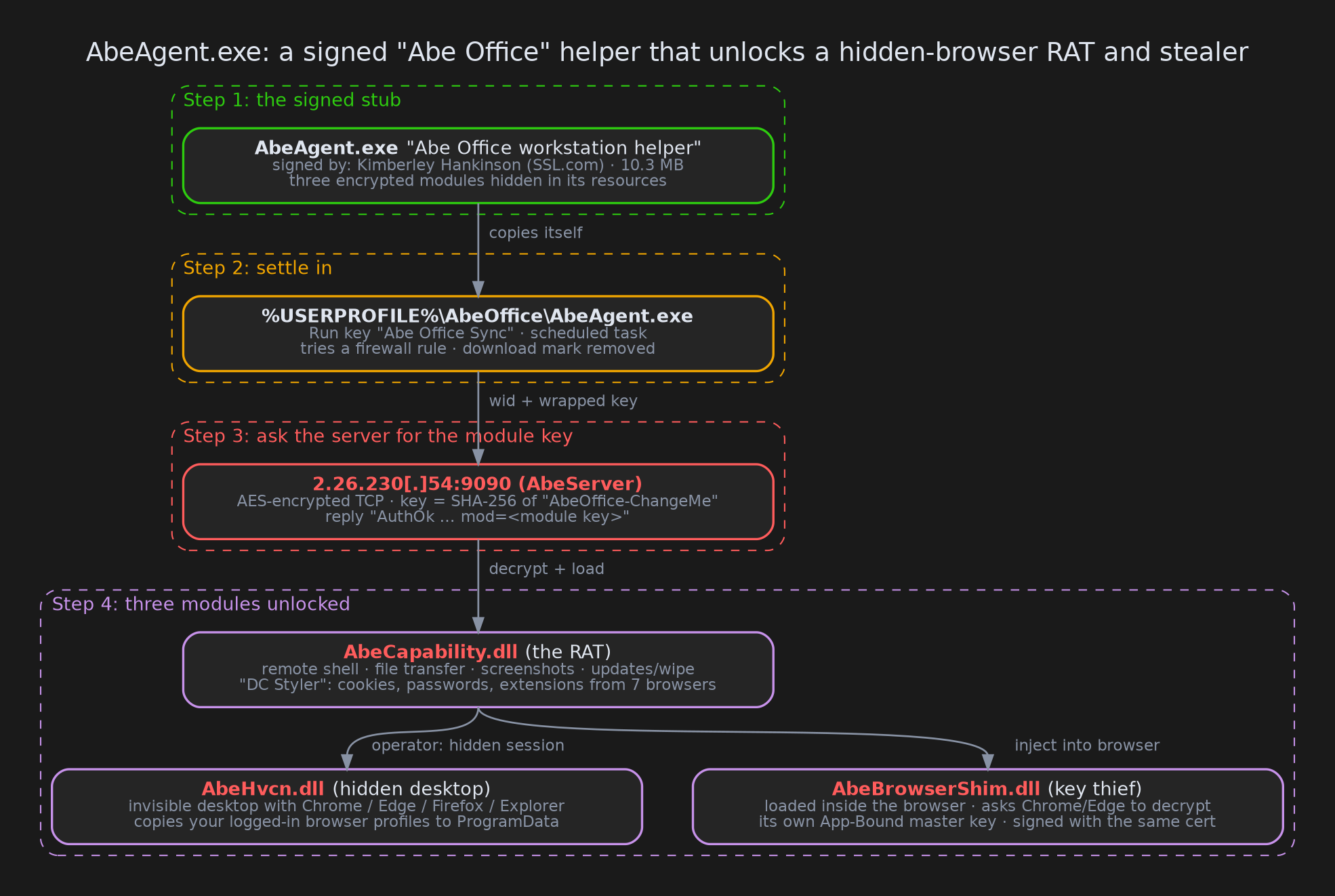
A newly analyzed remote-access trojan masquerading as an “Abe Workplace workstation helper” combines hidden-browser management with tooling designed to bypass Chrome’s App-Certain Encryption.
Quite than breaking the cryptography, its browser stealer injects a helper into Chrome and requests decryption from contained in the trusted browser course of.
The equipped evaluation credit MalwareHunterTeam with figuring out the pattern, AbeAgent.exe, and states that Claude, working via Claude Code on a REMnux digital machine, produced the investigation.
Sandbox testing uncovered interactive operator exercise, though researchers didn’t observe the cookie-stealing element execute.
AbeAgent.exe carries an SSL.com code-signing certificates issued in Kimberley Hankinson’s identify and was signed on November 4, 2026.
Its browser helper carries the identical certificates. The signature identifies the signer and protects file integrity; it doesn’t set up that the purported workplace software is official.
After execution, the loader copies itself into %USERPROFILEpercentAbeOffice, removes Mark of the Internet, and establishes persistence via the “Abe Workplace Sync” Run worth and a scheduled job. Each launch the executable with --autostart.
Three encrypted add-ons present the operational capabilities: AbeCapability.dll handles RAT capabilities, AbeHvcn.dll provides hidden-desktop entry and injection, and AbeBrowserShim.dll requests browser-key decryption.
Though the loader calls for an unlocking key from its server, researchers recovered it offline utilizing the embedded default password AbeOffice-ChangeMe.
The identical password underpins community encryption, permitting captured communications to be decrypted.
Google launched App-Certain Encryption for Home windows cookies in Chrome 127. Its privileged service validates the requesting software earlier than releasing protected knowledge, stopping unrelated functions from merely decrypting Chrome’s secrets and techniques.
Google explicitly recognized browser injection as a remaining assault route, albeit one which will increase detection alternatives.
Abe Workplace Malware
Rogue Authority Researchers stated that, Abe’s implementation follows that route. It launches an off-screen browser, injects AbeBrowserShim.dll, and asks the browser’s elevation service to decrypt its App-Certain key.
The helper writes the outcome to C:ProgramDataAbeOfficeabe_jobkey.dat.
The stealer, internally labeled “DC Styler,” comprises assortment routines concentrating on passwords, cookies, extensions, and payment-card knowledge throughout Chrome, Edge, Courageous, Opera, and Firefox.
Its App-Certain bypass targets supported browser implementations, not Firefox separate safety mannequin.
The hVNC element copies Chrome and Edge profiles into C:ProgramDataAbeOfficeSystemCache and opens them on an invisible Home windows desktop.
This offers operators a path to work together with current periods from the compromised machine.
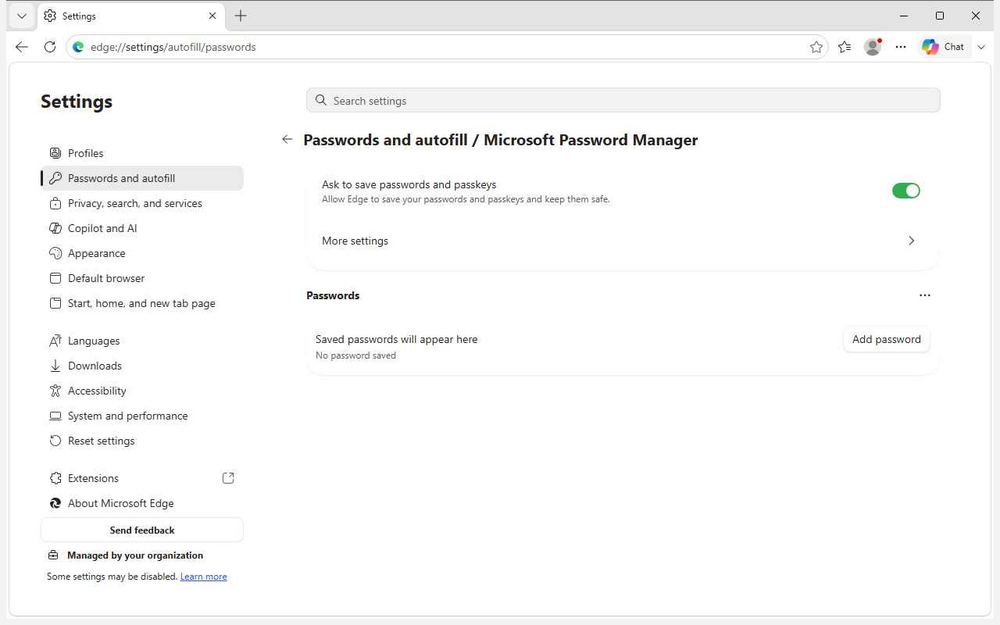
Throughout prolonged sandbox remark, the operator opened each browsers and navigated on to their password-management pages.
The profiles contained no saved passwords. Researchers reported no noticed stealer execution, remote-shell exercise, or further payload deployment.
The first command-and-control endpoint was 2.26.230[.]54:9090. A second server, 87.199.195[.]141, hosted an identical obtain web page.
VirusTotal associations linked 133 information to the infrastructure, however these hyperlinks don’t set up that each file shares similar performance.
Defenders ought to examine AbeOffice directories, its persistence artifacts, connections to each servers, browser injection, and off-screen launches utilizing --window-position=-32000,-32000.
Localhost distant debugging warrants correlation with suspicious guardian processes slightly than standalone classification.
For confirmed infections, isolate the endpoint, revoke browser periods, and reset vital credentials from a clear system.
Supply stays unknown, and the suspected relationship between related bootstrap loaders and archive packages stays unconfirmed.
The noticed exercise helps a credential-focused operation, however attribution and the total an infection chain stay unresolved. Session entry from the sufferer’s system shouldn’t be handled as inherently reliable.
Indicators of compromise
| Sort | Worth | Word |
|---|---|---|
| SHA256 | eda3e8e4e87ccb0423886ae5cfd1d488481d4ce16ab5b5efdfbce6f9f1a35dd9 |
AbeAgent.exe |
| SHA256 | 977f5a0124c4484772517336019d8f9a03d27abf9207b64ff225b7b35c7ff277 |
AbeCapability.dll (important RAT) |
| SHA256 | 3cec97aadc8e0da11e89a4aa454829292599b6b852afa620bb0aa811e9662d71 |
AbeHvcn.dll (hidden desktop) |
| SHA256 | 681293cbcf1436de6d8ae4c358a1e76677593155fe393055376aa535809b5ffd |
AbeBrowserShim.dll (signed) |
Word: IP addresses and domains are deliberately defanged (e.g., [.]) to forestall unintended decision or hyperlinking. Re-fang solely inside managed menace intelligence platforms comparable to MISP, VirusTotal, or your SIEM.
Stops Cyber threats earlier than impression with 21 min sooner MTTR. Combine ANYRUN’s Sandbox in your SOC.