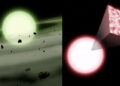
Highschool science class taught us that stars are available very particular colours. You’ve got cooler stars which are purple, orange and yellow. Then you’ve hotter, bigger stars which are white and blue. It seems that very similar to the wind within the film Pocahontas, stars additionally are available all kinds of colours, together with inexperienced and pink.
The invention was outlined in a examine printed this month in RAS Strategies and Devices. In keeping with the lead writer, Mark Hollands of Warwick College’s astronomy and astrophysics group, the common-or-garden white dwarf star is the centerpiece of this chromatic curiosity.
“Most stars, together with most white dwarfs, behave like ‘excellent radiators,’ so their coloration is ready virtually fully by temperature. However no one had actually regarded into what else is perhaps potential for white dwarfs,” Hollands stated in a press release. “It seems these extremely dense stars can produce colours no one anticipated, and a few of them genuinely shocked me.”
Hollands says that the secret’s density and environment. White dwarfs are among the many densest objects within the identified universe, and that additionally contains the environment across the white dwarf. Because of the extraordinary gravity, a white dwarf’s environment — which consists primarily of hydrogen and helium — can have some fascinating interactions with hint quantities of different components which are current.
“For white dwarfs with a cool, helium-dominated environment, because the star will get cooler, the helium turns into increasingly clear, which suggests you’ll be able to see additional into the star the place the fuel will get denser,” Hollands advised CNET in an e mail. “When you’ve hint components within the star, whether or not it’s metals like sodium and calcium from a planetary system, or carbon from the core, they work together with the dense helium.”
These interactions trigger the hint components to soak up mild throughout the wavelength, for a wider vary of “lacking” colours. The result’s a white dwarf that would seem in any variety of colours primarily based on what hint components it absorbed.
So, there are inexperienced stars on the market?

That’s exactly what Hollands and his crew discovered of their analysis. To this point, nobody has ever seen a white dwarf star with human eyes, and none is shut sufficient to be seen immediately. Most evaluation of a star is finished with spectroscopy, so scientists know what a star is manufactured from and the way vivid it’s. Usually, scientists focus extra on the science and issues like chemical make-up and brightness, fairly than coloration.
“As astronomers, we spend extra time serious about the technical questions on physics,” Hollands stated. “It’s a quite simple query to ask, ‘what do these stars truly seem like if you go to them,’ one thing I see members of the general public ask on a regular basis. It seems it wasn’t truly too tough to reply.”
Hollands and his crew used the identical knowledge for 151 white dwarf stars and ran it by way of a simulation that transformed it to human coloration imaginative and prescient. Of these, 146 have been fairly regular, averaging about 6,800K in coloration temperature. These would seem vivid white to people, with possibly the tiniest trace of blue.
The opposite 5 outcomes have been much more fascinating: The crew discovered examples of cyan, yellow, purple/violet, pink and, sure, even inexperienced. The inexperienced star is known as WD J1330+6435, and it’s a white dwarf that sits in a rocky planetary system. The particles from that system will get pulled into the star, lending it the hint components wanted to show a “ghostly inexperienced,” per Hollands.
One other fascinating discover was WDJ0902+2010, a star that has a ton of carbon in its environment. In keeping with the examine, this cooler white dwarf churns up carbon from its innards, and the carbon within the environment absorbs mild throughout the spectrum. It leads to a star that would seem salmon-pink to people.
For the reason that researchers might discover no different credible studies of a inexperienced star being found earlier than, WD J1330+6435 is probably going the primary inexperienced star ever found. Hollands stated that the pink and cyan colours have been additionally doubtless firsts, as there aren’t any studies of astronomers discovering stars in these colours both.
Sadly, the celebrities gained’t keep in these colours endlessly. Hollands says that white dwarfs begin out intensely sizzling — about 100,000 levels Kelvin — which might give them a “sky blue coloration.” This adjustments because the white dwarf cools, and also you solely get the actually cool colours when it reaches about 5,000K or so. Finally, the excessive gravity will pull the hint components into the core of the star, altering it again to its regular white or orange colours.
The lone exception is the pink star. Since its carbon already comes from inside the star, the star’s pure convection forces are inflicting that coloration. Meaning WDJ0902+2010 is more likely to stay pink for billions of years, whereas the remaining will doubtless shift again to their pure colours after just a few million years.