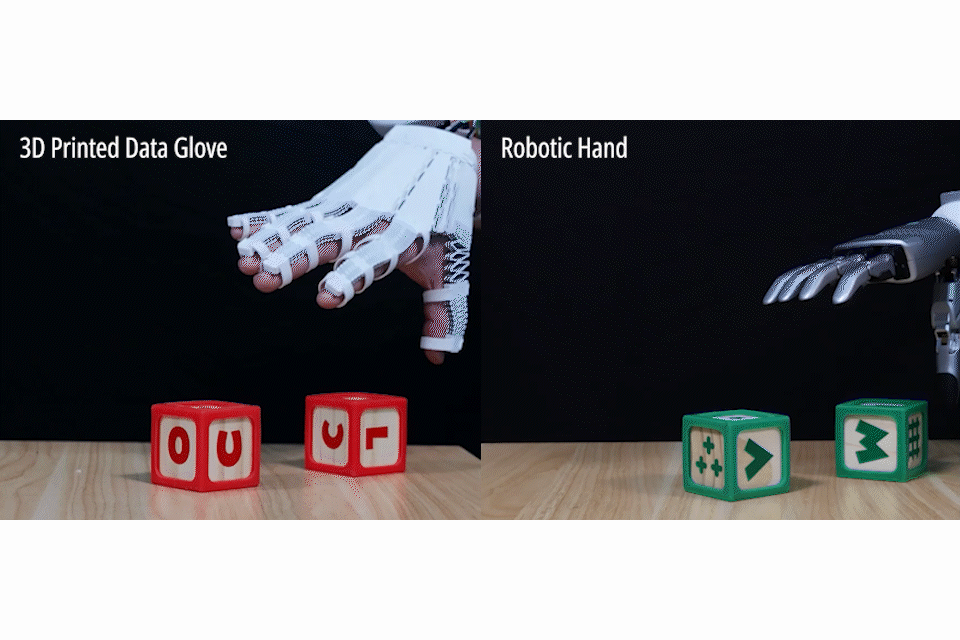
Jiaji Li and lead writer Xiang Chang, a TJU PhD pupil and visiting researcher at CSAIL, used X-Hinges to create many intelligent gadgets. For instance, they made a glove that may train a robotic the right way to grasp blocks. It adjusts to the scale of a consumer’s arms, then information how the joints of their fingers bend through sensors earlier than quickly relaying that data to a humanoid hand to imitate it. The glove might be helpful in factories or houses, the place a robotic typically must be taught new interactions shortly.
The researchers additionally produced a small, origami-style lamp utilizing X-Hinges. It senses when a human pinches it closed and adjusts its brightness accordingly. Once you activate this adaptive, moveable gentle supply (type of like a studying gentle), it seems to be like a chunk of folded-up paper that sprouts right into a lamp.
X-Hinges may even assemble gadgets that establish which objects have been positioned on it. You could possibly put a banana on prime, as an illustration, and it’ll acknowledge the fruit virtually instantly primarily based on the tactile information it’s recorded utilizing its sensors. This superior bodily consciousness might be built-in into detection methods in locations corresponding to airports and grocery shops.
Behind every of the scientists’ creations is an easy-to-use interface that helps you design interactive objects from scratch. Customers can select how every a part of their design seems to be and strikes, simply because the researchers did when making a online game controller that resembles a cartoon shark.
X-Hinges provides you 4 shapes to select from: a customized possibility, cylinder, rectangle, and skinny define. To recreate the distinctive look of a shark’s tail, the researchers designed their very own form. They then selected how the toy bent, choosing its tail to maneuver up and down, type of like a joystick. Lastly, this system embedded the sensors, and the scientists 3D-printed their system.
The researchers say that X-Hinges’ various motions are a novel function in comparison with previous makes an attempt to 3D-print responsive on a regular basis objects. “Most strategies solely permit for one axis of movement, typically as a consequence of sign interference. X-Hinges allows your 3D-printed merchandise to maneuver from three angles,” says Chang. “In the end, you get a design with the meant motion you need. It additionally information movement information in every of these areas on the identical time, making the system attentive to completely different sorts of interactions.”
The instrument may assist understand the untapped potential of the seemingly mundane. Objects we use on daily basis for a particular objective, like a water bottle for consuming or a lamp for lighting, may turn out to be interactive devices. Very similar to how a chatbot makes use of a type of digital intelligence to reply your prompts, an object may leverage a form of bodily intelligence to execute a bodily job when customers work together with it.
For now, although, X-Hinges faces a calibration bottleneck. Every time an merchandise is 3D-printed, its structure {of electrical} components varies barely, so two gadgets that seem similar from the skin might not make the identical sensor readings. That is essential for those who’re constructing a deformable health glove, as an illustration, for 2 separate customers. To repair this, Chang and Li constructed a pc imaginative and prescient system that may recalibrate outputs to align, making certain information is correct throughout two of the identical objects, though they hope to develop a built-in sign recalibration mechanism sooner or later.
That ambition traces again to the throughline in Jiaji Li’s personal analysis: letting actuation and sensing “develop” instantly inside a 3D-printed object, as a substitute of including them on afterward. He beforehand constructed printed tendon-driven mechanisms that gave objects the flexibility to maneuver; X-Hinges is how he’s now constructing on the flexibility to sense. The subsequent step, he says, is combining the 2 in a single print — it’s actuation and sensing born collectively in the identical fabrication course of, opening the door to new bodily platforms for embodied intelligence and AI brokers.
Chang and Li wrote the paper with MIT affiliate professor of EECS and CSAIL principal investigator Stefanie Mueller and up to date TJU graduate Haiyang Yan. Their work was supported, partly, by a postdoctoral analysis fellowship from Zhejiang College and the MIT-GIST Program.
The researchers will current their work on the ACM Symposium on Person Interface Software program and Expertise in early November.