Scholarship from throughout SHASS and past
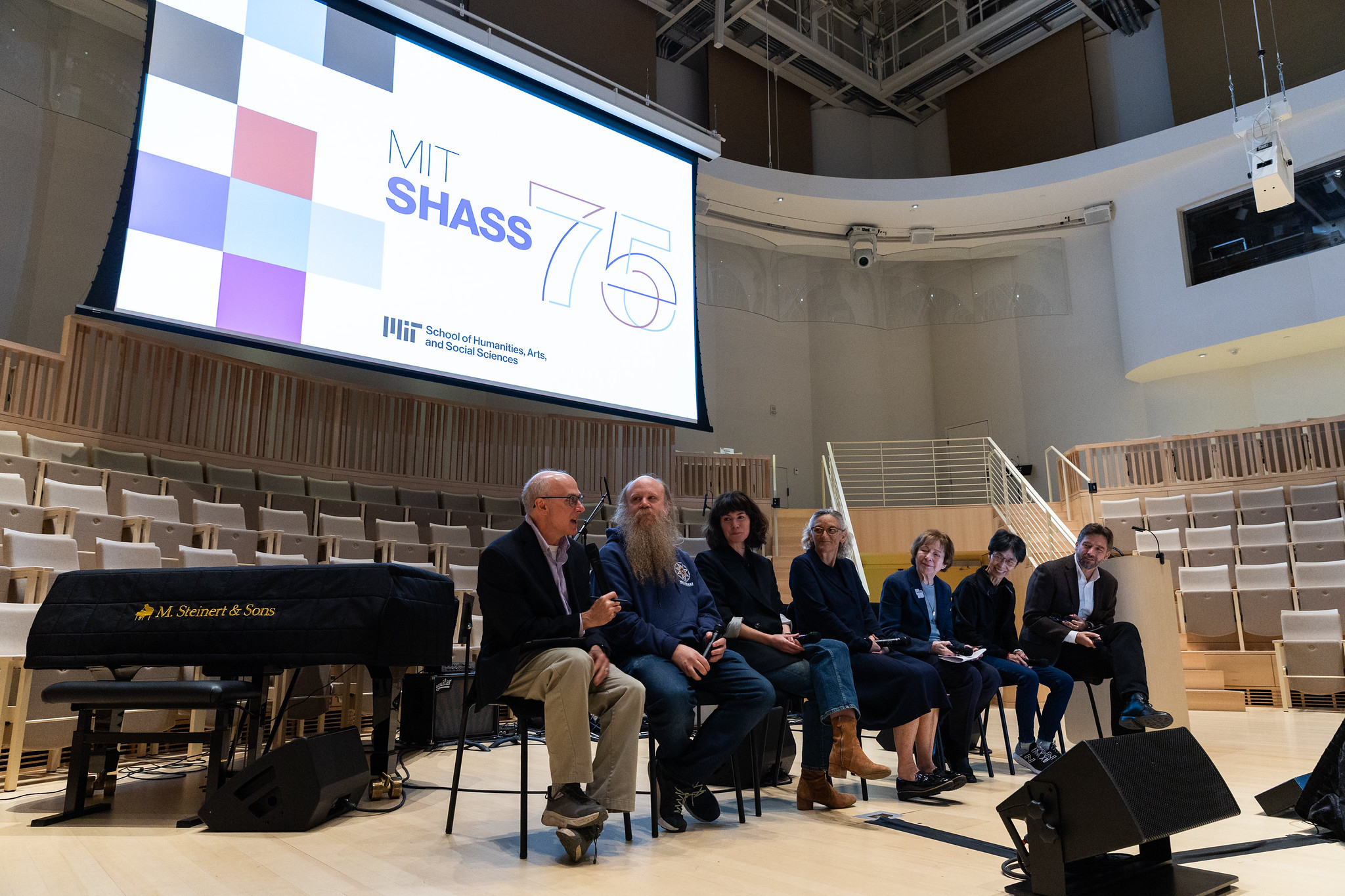
Over the symposium’s two days, analysis shows, panel discussions, and performances provided attendees alternatives to have interaction with the function of SHASS in exploring right now’s largest societal questions.
“We collect not a lot to look again over the previous 75 years, however to showcase the place we at the moment are, and share what we urgently goal to sort out collectively within the years forward,” stated David Kaiser, Germeshausen Professor of the Historical past of Science and professor of physics at MIT, who additionally served as chair of the symposium planning committee.
The primary day included a session on educating and studying improvements. College offered on the success of instructional packages housed inside SHASS, together with the MIT Indigenous Languages Initiative Grasp’s Program, the Grasp in Information, Economics, and Design of Coverage (DEDP), and MISTI, the hub for world experiences for MIT college students.
Stephanie Seed, affiliate professor of literature, spoke about why she and others are working to reintegrate traditional books into their educating.
“MIT, after all, is an establishment unusually oriented in the direction of the long run,” she stated. “Our college students are skilled to think about and create worlds that don’t but exist. And it’s exactly this future orientation that makes studying the previous particularly necessary right here.”
Eric Klopfer, professor of Comparative Media Research/Writing and co-author of MIT’s latest report on AI and instruction, stated it is a second when instructors should reassess how programs are taught.
“I don’t know precisely what that appears like, however I do suppose it means one thing that’s greater than modifying our curriculum. I believe it actually means rethinking what the academic expertise is,” he stated.
Throughout a session on computing and society, panelists described totally different views and analysis into know-how and the way it impacts people.
“We challenge elements of ourselves onto computational programs,” stated MIT Professor D. Fox Harrell throughout his discuss seeing “selfness” in machines.
“What makes an AI system isn’t just the code, not simply the programming or the algorithm, it’s the truth that we narrate it as being intentional,” he stated.
Program in Science, Know-how, and Society Professor Sherry Turkle provided a skeptical view of human-technology interplay, notably with AI chatbots, which she describes as “intimate machines.”
“If social media got here for our consideration, I argue that chatbots are coming for our capability for attachment, which is deeper and way more troubling,” stated Turkle.
Professor David Autor, head of the Division of Economics, stated it’s an thrilling time to be working at MIT, the place students are collaborating to discover AI’s impression on society.
“I don’t suppose there’s an in depth analogy to a second when everybody felt the world change so rapidly,” he stated. “The stakes really feel extremely excessive.”
Celebrating the humanities and fascinating with the long run
The primary day concluded with a rousing Music and Theater Arts efficiency showcase, which started with an excerpt from Stan Lai’s “A Dream Like A Dream,” a play directed and carried out by college students and instructors at school 21T.100 (Theater Arts Manufacturing).
“Variations on the Theme of SHASS 75,” a chunk choreographed by Dan Safer, senior lecturer and director of dance packages, mixed motion, lighting, and music in a celebration of each the human physique and the college’s milestone anniversary.
Pupil and college musicians from quite a lot of types and disciplines shared the stage, together with Rambax MIT, MIT Live performance Choir, and the MIT All-Star Jazz Combo. The showcase included stirring renditions of “Madrigal,” composed by Vice Provost for the Arts Keeril Makan, and “Prayer for Peace.”
On the second day of the symposium, a number of alumni offered on their present work and the impression of their SHASS experiences.
Jessica Coon PhD ’10, now a professor of linguistics at McGill College, spoke concerning the main function MIT Linguistics performs in preserving endangered languages, and the way her research at MIT ready her to hold on that work.
“SHASS provides us the instruments not simply to conduct analysis, however to speak the impacts of this analysis throughout quite a lot of totally different audiences and in numerous methods,” she stated.
Ankita Reddy ’19 double-majored in anthropology and biology and is now an MD/PhD pupil on the College of Pennsylvania. She highlighted her most impactful SHASS programs, together with 21A.308 (International Psychological Well being).
“This was the primary time I used to be pressured to think about how good well being care appears to be like totally different based mostly on social programs and cultural practices,” she stated. “SHASS made me extra comfy with, and extra interested in, complexity.”
In the course of the symposium’s last session, panelists engaged in a dialog about AI, artwork, and the implications for creatives in an period the place their artwork will be co-opted and copied.
“There’s a lot reward for brand spanking new and upgraded applied sciences,” remarked affiliate professor of literature Sandy Alexandre. “The query I persistently have is: What does it imply to be an upgraded human being? How are we innovating as know-how is innovating?”
Thinker Justin Khoo stated AI’s function in artwork may very well be thought of a “big paint brush you don’t have a lot management over,” including he might see the creation of recent sub-genres of artwork which are human-only, AI-infused, and purely AI, for instance.
Khoo closed by saying he encourages college students to “suppose broadly, and actually take severely the humanistic training right here at MIT.”
“A broad understanding of a set of ideas that are broadly relevant, not simply narrowly relevant, I believe that’s what we’d like greater than ever now,” he stated.
Because the symposium got here to an in depth, attendee Kent Sahin praised the occasion.
“I’ve attended each session, and it is a incredible program and a terrific celebration of the seventy fifth anniversary,” he stated. “Clearly, whether or not it’s AI impression, the impression of local weather change, or the impression of political and social change, SHASS is in the suitable place on the proper time.”