Cybersecurity researchers have demonstrated a covert channel that would enable malware to extract delicate info from air-gapped computer systems by manipulating USB power-management settings and observing the ensuing alerts.
Known as SPECTER, the approach was developed by Hyeongjun Choi, Ji Hyuk Jung, and Ji Gained Yoon of Korea College in Seoul, South Korea. Their analysis explores how routine USB management operations can transmit info even when typical community connections are unavailable.
Turning USB Management Operations Into Indicators
Air-gapped methods are bodily remoted from exterior networks to scale back the danger of unauthorized knowledge transfers. Nevertheless, if an attacker compromises a machine, various communication paths should still be obtainable.
SPECTER requires malware to have root or administrator privileges on the compromised host. It encodes info by way of USB power-management or device-state operations with out inserting the payload in USB knowledge transfers. The approach includes modifications to peripheral {hardware} or firmware.
Three Methods to Get well Knowledge
The researchers examined SPECTER on Home windows 10 and Ubuntu 22.04, demonstrating three other ways to recuperate the alerts.
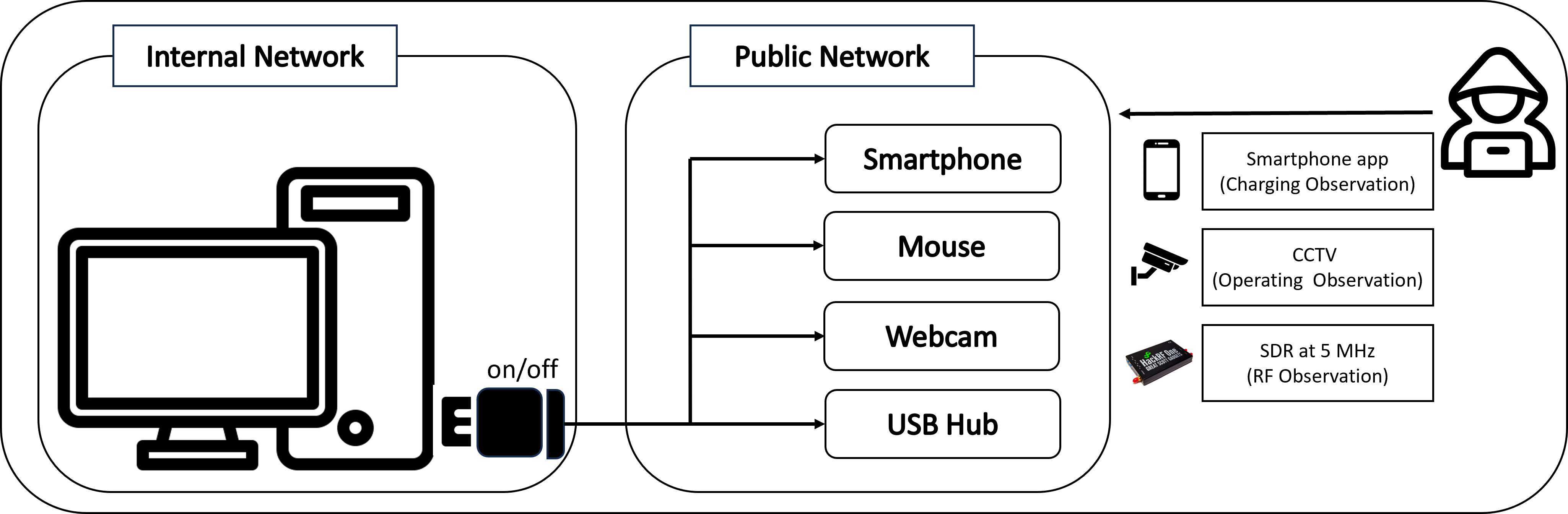
One methodology makes use of smartphone charging states. Researchers used an Android app to learn battery-status updates from a Samsung Galaxy S22 working Android 14. On an iPhone 13 Professional working iOS 17.4.1, they watched the on-screen charging indicator as a substitute. The reported signaling charges had been 0.2 bits per second on Ubuntu and 0.25 bits per second on Home windows for each telephones.
In addition they examined whether or not adjustments in USB peripherals may carry the sign. On a Home windows laptop computer, a mouse stopped responding and its LED turned off when disabled, supporting signaling at 1 bit per second. A webcam and USB hub additionally produced usable alerts at 0.25 bits per second.
Researchers didn’t get hold of usable channels with the examined keyboard or headset dongle configurations. Not one of the examined peripherals produced a usable channel on the Ubuntu desktop, exhibiting that outcomes rely on the host and {hardware} configuration.
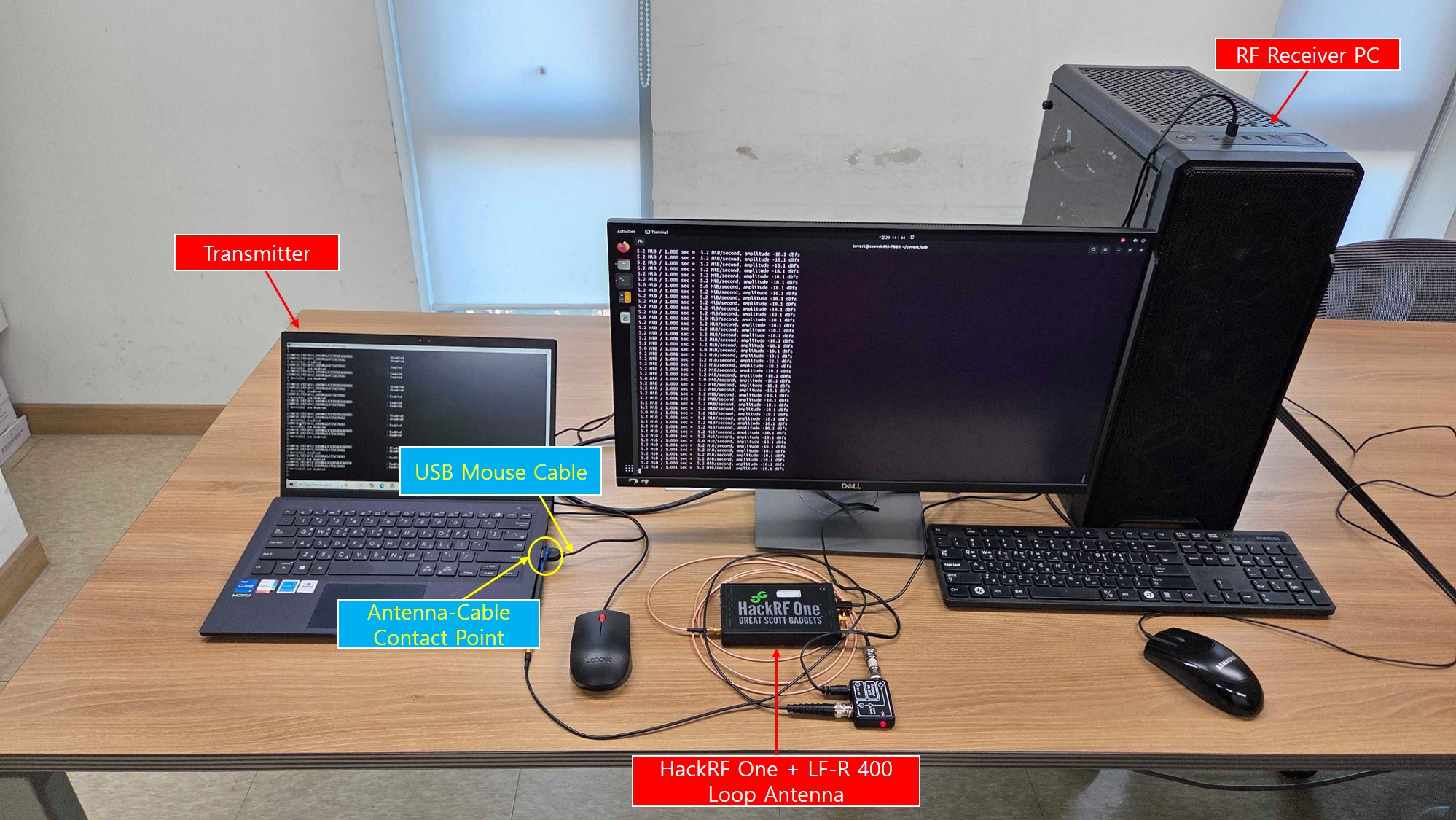
The third methodology detects near-field electromagnetic exercise related to USB management operations. Utilizing a HackRF One software-defined radio and an LF-R 400 loop antenna in direct contact with the USB cable, the researchers captured alerts close to 5 MHz. The experiments didn’t set up dependable reception at a distance.
Low Speeds Restrict the Risk
At these charges, SPECTER is unsuitable for transferring giant quantities of knowledge. Its potential use lies in extracting brief, beneficial secrets and techniques, corresponding to credentials, authentication tokens or cryptographic keys. Nevertheless, the experiments don’t set up a basic error fee or dependable reception at a distance for the RF methodology.
The findings additionally spotlight limitations to the approach’s stealth. USB management operations can set off charging notifications, display exercise or interruptions to linked peripherals, relying on the configuration.
Researchers suggest treating USB power-management and device-state occasions as security-relevant telemetry. Monitoring repeated machine allow, disable, droop and resume operations may assist establish suspicious exercise, though the effectiveness of such detection stays to be evaluated.
The total analysis paper is obtainable on arXiv.